Ask ten people “What is the safest form of transport?” and most will say airplanes, a few will say trains, and one will insist they feel safest behind their own wheel. Each answer holds a grain of truth, which is why the question never goes away.
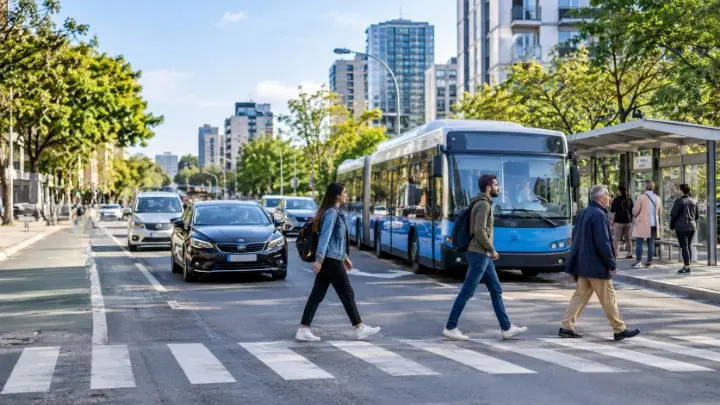
Compare modes mile for mile and the statistics give a clear ranking. The trouble is that almost nobody lives their daily life on a commercial flight. Most of us make short trips by car, van or bus, and for older adults, wheelchair users and anyone recovering from a procedure, the ride itself adds risks that mileage tables never capture: the step up into a vehicle, the ramp, the transfer out of a wheelchair, the walk from the curb to the clinic door.
This guide starts with the short answer, then explains how transport safety is measured, how the main modes compare and what “safest” means for a trip to dialysis or home from the hospital. You’ll also find a checklist for vetting any medical ride. We provide non-emergency medical transportation in Sacramento, CA, so the second half draws on what we handle every day.
Quick Answer: What is the safest form of transport?
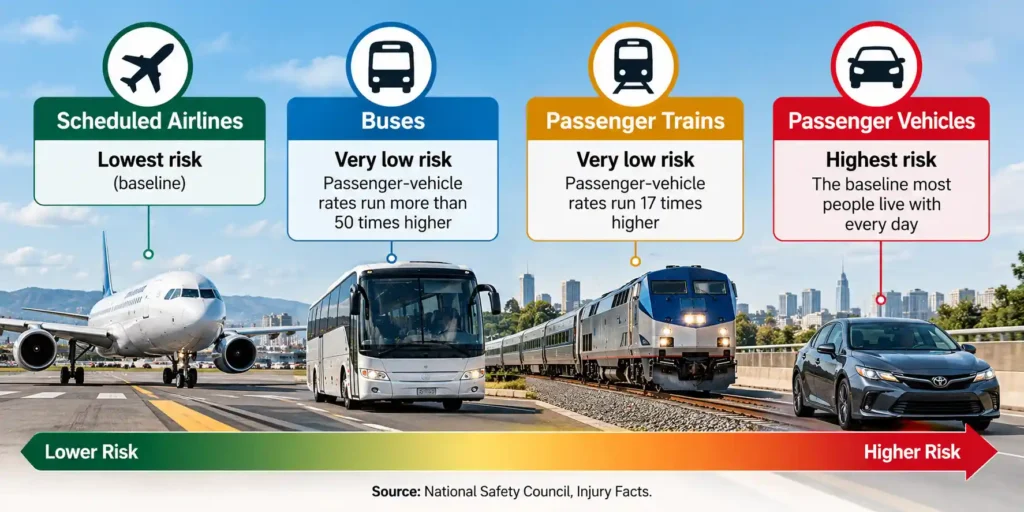
Per passenger mile, scheduled commercial air travel is the safest form of transport in the United States. Buses and passenger trains come next, passenger vehicles carry far more risk, and motorcycles carry more still. For short everyday trips where flying isn’t an option, the safest choice is usually a trained professional driver in a well-maintained vehicle with the right restraints for the rider.
The National Safety Council tracks the comparison in its Injury Facts data, measured as deaths per 100 million passenger miles. Over the most recent ten years it reports, passenger-vehicle death rates ran more than 50 times higher than the rate for buses, 17 times higher than for passenger trains and about 1,000 times higher than for scheduled airlines.
From lowest risk to highest:
- Scheduled airlines: the lowest risk per mile by a wide margin
- Buses: very low risk, and ahead of trains in the National Safety Council’s U.S. figures
- Passenger trains: very low risk too, and far below cars
- Passenger vehicles (cars and light trucks): the baseline most people live with every day
- Motorcycles, walking and cycling: more exposure, because nothing encloses the traveler
No mode has zero risk, and no ranking can promise that one particular trip will go smoothly. What the numbers do show is where the risk piles up, and that’s the part you can plan around.
How Transport Safety Is Actually Measured
Researchers don’t have one number for safety, because the answer shifts with the yardstick. These are the measures you’ll see most often:
| Measure | What it tells you | Where it can mislead |
| Deaths per passenger mile | Risk for a given distance. The standard way to compare modes; the National Safety Council uses deaths per 100 million passenger miles | Favors modes that cover long distances, such as aircraft |
| Deaths per trip | Risk each time you board | Treats a ten-minute car ride and a six-hour flight as one trip each |
| Deaths per hour traveled | Risk for time spent in transit | Penalizes fast modes, because they cover more miles per hour |
| Injuries and hospital stays | How often incidents cause harm short of death | Reporting rules differ by mode and country, so comparisons are rough |
Why two reports can disagree
Rankings differ from one source to the next for ordinary reasons:
- They cover different years, and rates move from year to year.
- They cover different countries, with different roads, rail systems and reporting rules.
- They define modes differently, such as what counts as a “bus” and whether crew and ground staff are included.
- They divide by different things. Airline figures are usually per passenger mile, while driving figures are often per vehicle mile, which ignores how many people ride in each vehicle.
- They change methods. The National Safety Council notes that its source for passenger-mile estimates changed in 2016, which lowered the rates for buses and rail, so older and newer figures shouldn’t be lined up without care.
Treat any ranking as a direction, not a decimal point. Airlines sit at or near the top of nearly every list. The order of buses and trains is the kind of detail that moves with the source: an early-2000s European Transport Safety Council overview put coach travel at about twice the risk of air or rail per passenger kilometer, the reverse of the order in the National Safety Council’s U.S. figures.
The Safest Modes of Transport Compared
Here is how the main modes line up on the measure researchers use most, risk per passenger mile. The multiples come from the National Safety Council’s U.S. data, and the motorcycle comparison comes from the National Highway Traffic Safety Administration (NHTSA).
| Mode | Risk per passenger mile (U.S.) | Why it performs that way | Everyday limits |
| Scheduled airlines | Lowest. Passenger-vehicle rates run about 1,000 times higher | Professional crews, mandatory inspections, controlled airspace, no oncoming traffic | Long distances only, and you still need a ground ride at both ends |
| Buses | Very low. Passenger-vehicle rates run more than 50 times higher | Trained professional drivers and a large vehicle body around the rider | Fixed routes and stops, and boarding can be hard for some riders |
| Passenger trains | Very low. Passenger-vehicle rates run 17 times higher | Mostly separated from road traffic, with signaling and trained crews | Service is limited in many areas |
| Passenger vehicles (cars and light trucks) | The baseline for comparison | Driver skill, fatigue, distraction, weather and other drivers all affect the outcome | The most flexible option, and the one with the most exposure |
| Motorcycles | Far higher than cars: almost 27 times the car-occupant rate per vehicle mile (NHTSA, 2024) | No enclosure around the rider | Rarely suited to anyone with limited mobility |
| Walking and cycling | Exposed to traffic | No protective shell in a collision with a vehicle | Practical only for short trips and riders who are steady on their feet |
The multiples for airlines, buses and trains come from the National Safety Council. NHTSA’s 2024 data put the motorcyclist fatality rate at 28.00 per 100 million vehicle miles traveled, against 1.05 for passenger car occupants. That measure counts vehicle miles rather than passenger miles, so it isn’t directly comparable with the other rows, but the gap is too large to ignore. Walking and cycling share the same problem: nothing protects the traveler in a collision with a vehicle.
Why airlines come out ahead: commercial flying is tightly controlled from the cockpit to the maintenance hangar. Crews are professionals, inspections are mandatory and there’s no oncoming traffic. Failures are rare, but each one becomes front-page news, which is why flying feels riskier than the numbers say. Most of a flight’s risk sits in takeoff and landing, so short hops carry more risk per mile than long flights.
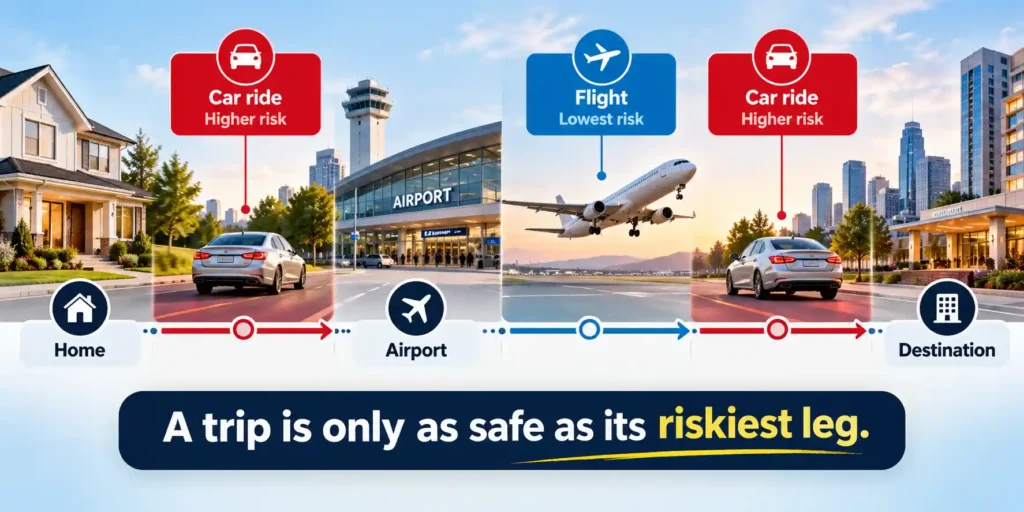
The weak link is usually the car. Passenger vehicles account for most transportation deaths mainly because most trips happen in them. Even a flight-heavy itinerary includes a car ride to the airport and another at the far end, so the ground legs deserve as much thought as the flight.
Why the Safest Mode Is Not Always the Safest Trip
You never book a mode in the abstract. You book a trip, and three things change the answer: how far you’re going, what service actually runs between your two points, and who is riding. Nobody flies to a dialysis center ten minutes away, and a train doesn’t stop at every clinic door.
| Trip | Safest practical choice | Why |
| Cross-country or overseas | Scheduled commercial flight | Lowest risk per mile, as long as the ground legs are planned with care |
| Between nearby cities | Intercity bus or passenger train where service exists | Low risk per mile and no long stretch behind the wheel |
| Daily errands in town | Public transit where it works for you, or a trained driver when mobility, balance or recovery are concerns | Matches the ride to the rider |
| Medical appointments with limited mobility | Non-emergency medical transportation in a vehicle matched to the rider | Trained help, proper securement and door-through-door assistance |
| Sudden, severe symptoms or injuries | Call 911 | Emergencies need a medical crew, not a scheduled ride |
What is the safest form of transport? For Seniors, Wheelchair Users and Medical Trips
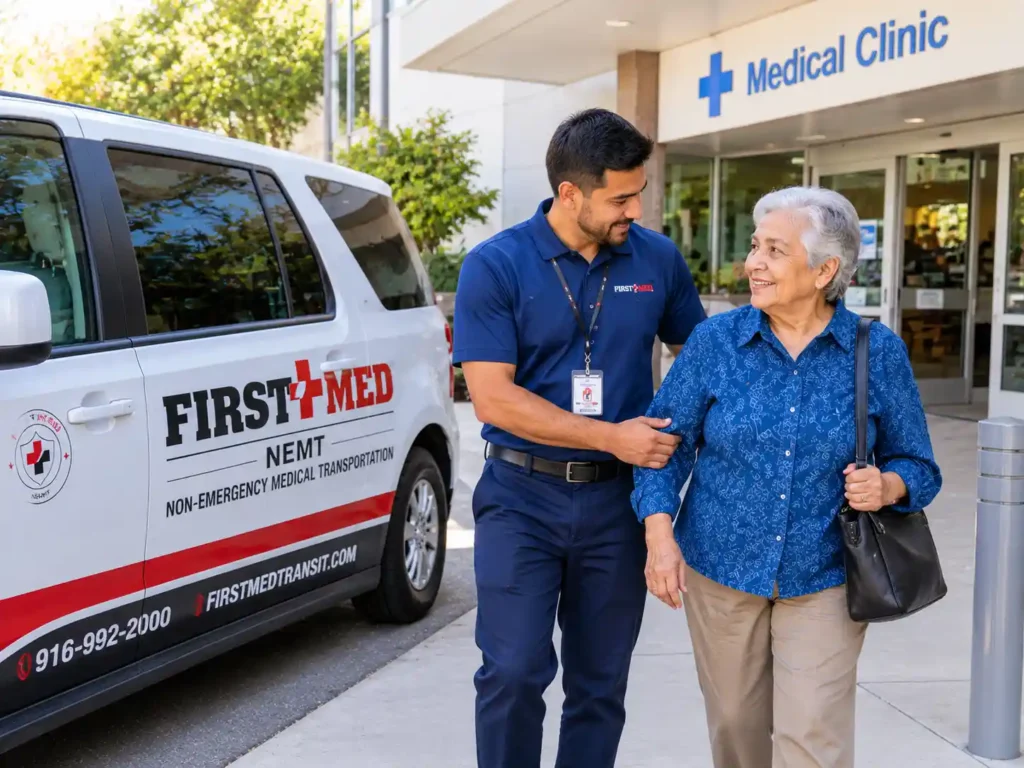
For these trips the choice isn’t plane versus train. It’s much closer to home: drive yourself, rely on a relative, call a taxi or rideshare, use public transit or paratransit, or schedule non-emergency medical transportation. The safest option is the one that looks after the whole trip, from the front door to the exam room, not only the miles in between.
What “safe” means when mobility is limited
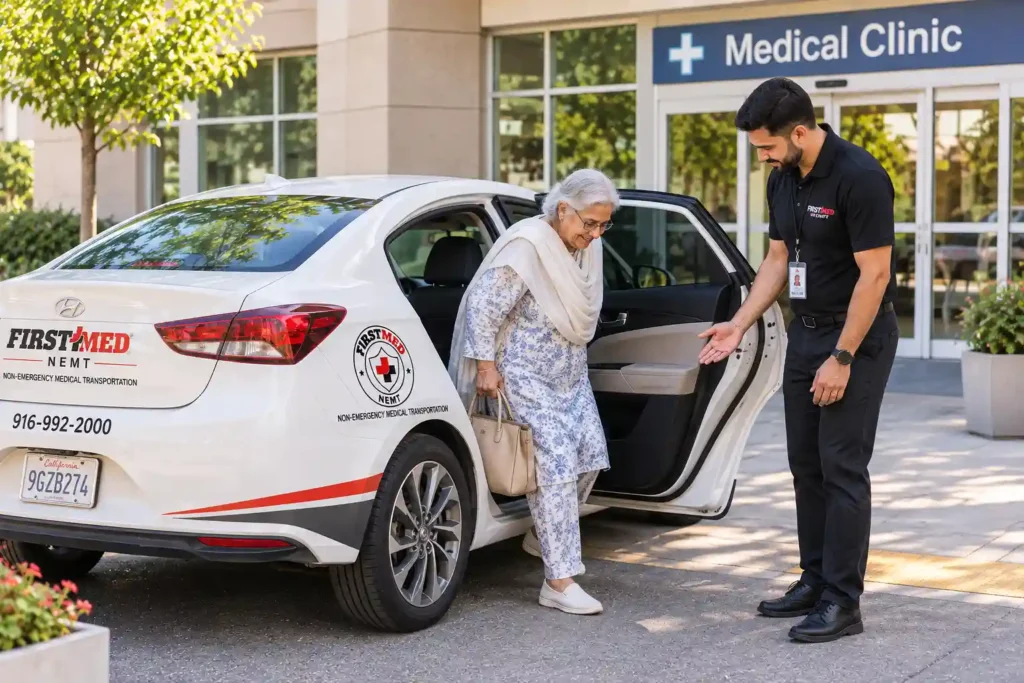
- Boarding and exiting: steps, curbs, ramps and gaps are risks even when the vehicle is parked.
- Transfers: moving from a wheelchair to a seat, or from a bed to a gurney, calls for trained hands.
- Securement: the wheelchair and the rider each need their own restraints.
- Crash protection: older bodies are more fragile, so a crash one rider walks away from can be far more serious for another.
- Fatigue: treatments such as dialysis, chemotherapy and radiation can leave riders tired or unsteady afterward.
- Hurry: a late pickup leads to rushed transfers, and rushed transfers are where mistakes happen.
The crash-protection point has research behind it. The Insurance Institute for Highway Safety reports that fatal crash rates per mile traveled start rising at about age 70, and that fragility, meaning a higher risk of dying in a given crash, is the main reason rather than a larger number of crashes. In 2024, 5,679 people age 70 and older died in motor vehicle crashes. Many older drivers already limit how much they drive, which is a good reason to line up a dependable alternative before you need one.
Your ride options compared
| Ride option | Trained help with boarding | Wheelchair securement | Carries someone lying down | Best fit |
| Driving yourself or a relative driving | No formal training | Only in a modified vehicle | No | Short trips for riders who can sit upright and transfer easily |
| Standard taxi or rideshare | Usually none | Usually not available | No | Independent riders who can climb into a car seat |
| Public transit | Limited | Securement space usually provided on buses | No | Riders who can manage stops, steps and transfers on their own |
| ADA paratransit | Varies by agency | Yes, in accessible vehicles | No | Eligible riders who can plan ahead and share a ride |
| NEMT ambulatory transport | Yes | Not needed | No | Riders who can walk but want a steady arm and door-to-door help |
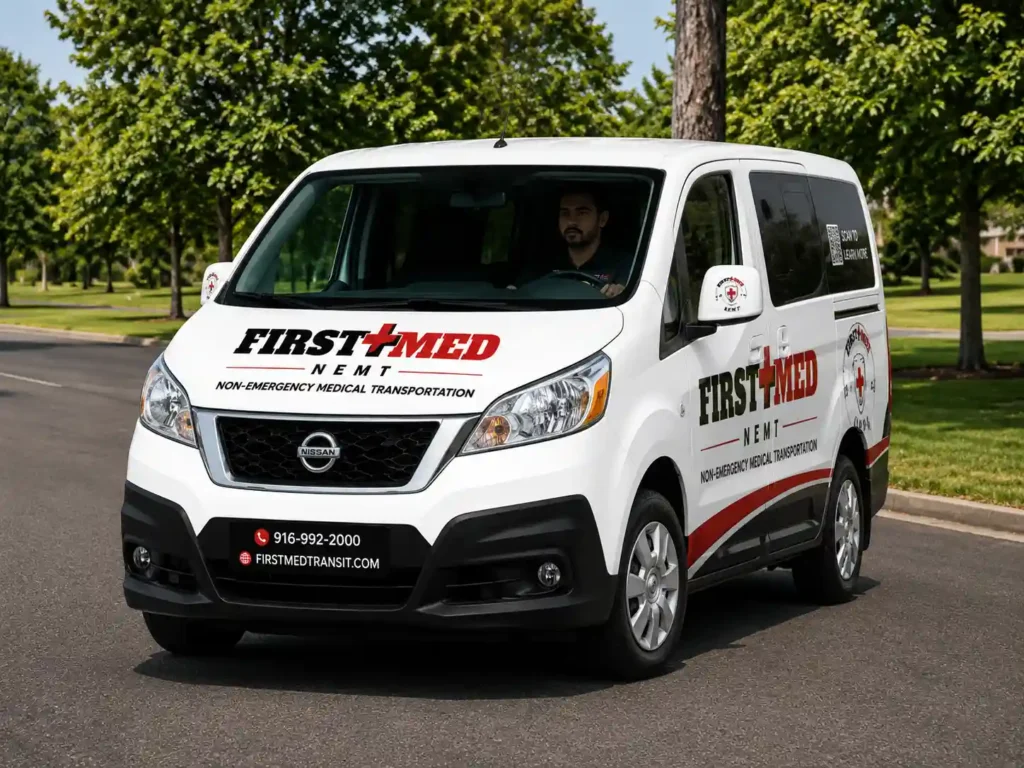
| NEMT wheelchair van | Yes | Yes, with tie-downs and occupant restraints | No | Riders who stay seated in a wheelchair |
| NEMT gurney van | Yes | Gurney secured in the vehicle | Yes | Riders who must lie down on a planned, non-emergency trip |
| Ambulance (911) | Medical crew | Yes | Yes | Emergencies |
Standard taxis and rideshares work for riders who can climb into a car seat on their own. Some areas also offer wheelchair-accessible versions, and our related blog post, does Uber do disabled taxis, covers what to expect. Paratransit, the service transit agencies provide under the Americans with Disabilities Act for riders who can’t use regular fixed-route service because of a disability, suits many eligible riders, though trips are usually booked ahead and often shared. Our related blog post, what is paratransit, walks through eligibility and costs.
Non-emergency medical transportation, or NEMT, fills the gap between a family car and an ambulance: ambulatory transport for riders who can walk but want a steady arm, wheelchair vans for riders who stay seated, and gurney vans for riders who must lie down. If the term is new to you, our post on what NEMT transportation is is a quick primer.
Why securement matters
A wheelchair that isn’t secured can shift, tip or slide in a sudden stop, and it becomes a hazard to its rider and to everyone else in the vehicle. Good practice uses two separate systems. Tie-downs anchor the wheelchair to the vehicle floor, and an occupant restraint, a lap-and-shoulder belt anchored to the vehicle, protects the rider. The belt that comes with the wheelchair itself is a different matter. The University of Michigan Transportation Research Institute’s wheelchair transportation safety guidance says positioning belts should not be used as an occupant restraint in a motor vehicle, because few are built to withstand crash forces. It recommends pairing them with a crash-tested restraint anchored to the vehicle that has both pelvic and upper-torso belts.
Recognized standards exist for this equipment. RESNA WC18 and ISO 10542-1 cover wheelchair tiedown and occupant restraint systems, and asking a provider whether its equipment is built to a standard like these is a fair question.
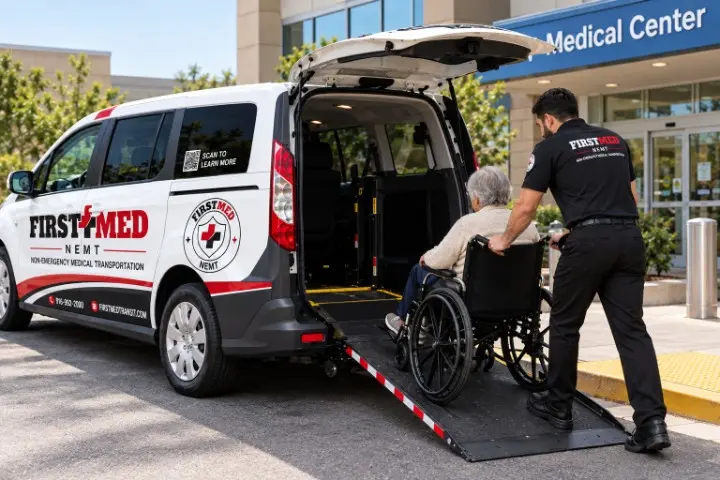
At First Med Transit, every wheelchair is secured with four-point tie-down restraints before the vehicle moves, and occupant restraints are used in addition so the rider and the chair are both protected. Our wheelchair-accessible vans come as side-entry or rear-entry models with powered or manual ramps or hydraulic lifts, and drivers are trained to operate the equipment. You can read more about wheelchair transportation in Sacramento on our service page.
A Safety Checklist for Choosing a Medical Ride
Any company can say it’s safe. These are the specifics worth asking about, and a good provider answers them without hesitation.
- Licensing and insurance. Ask whether the company is licensed and insured, and ask for proof if you want it.
- Driver screening. Look for background checks and a real training program, not just a driver’s license.
- Training that fits the job. Mobility assistance, safe transfers and wheelchair securement matter, and so do basic emergency skills such as CPR and First Aid.
- Vehicle upkeep. Ask about a regular inspection and maintenance schedule and about cleaning between trips.
- Proper securement. Tie-downs for the wheelchair and a separate belt for the rider.
- The right vehicle for the rider. Ramp or lift, side or rear entry, wheelchair space or gurney, settled when you book rather than at the curb.
- Hands-on help. Door-to-door or door-through-door assistance for riders who need it.
- Trip monitoring and a return plan. A dispatcher who tracks each trip, and a return ride arranged before you leave.
- A clear emergency rule. A non-emergency provider isn’t a substitute for 911, and a good one says so.
Here is how that looks at First Med Transit. We’re licensed and insured, our drivers go through background screening and a training program that covers mobility assistance and securing wheelchairs and equipment, and our team is CPR and First Aid certified. Vehicles follow a regular maintenance and inspection schedule and are cleaned between trips, and our dispatch team tracks each trip in real time. You can read more about our driver screening and training standards on our About Us page.
Special Cases: Lying-Down Rides, Dialysis and the Ride Home
When someone has to lie down
If sitting upright isn’t possible, neither a car nor a wheelchair van will do. A gurney van carries the rider lying down on a secured gurney for a planned, non-emergency trip, and trained staff handle the transfer from bed to gurney and back. Our gurney transport service covers hospital discharges, facility transfers and recurring appointments. For anything sudden or severe, call 911. If you’re unsure which level fits, the care team can tell you, and our related blog post, gurney transport vs ambulance, explains the difference.
Dialysis and other recurring treatments
Dialysis, chemotherapy and radiation come around several times a week, so the ride has to be dependable as well as safe. A standing schedule keeps the same standards in place at every visit. Because treatment can leave riders worn out, door-through-door help and a confirmed return ride are part of safety, not extras. Our dialysis transport service is built around recurring schedules.
Hospital discharge and the ride home after a procedure
Leaving the hospital is a vulnerable moment. Many facilities want a responsible adult to take someone home after sedation or anesthesia, and policies on taxis and rideshares vary, so ask before the day. Our hospital discharge transport team coordinates with discharge staff so timing and handoffs line up. If you’re short on rides home, our related blog posts, how to get a ride home from a medical procedure and what to do if you have no one to drive you home from the hospital, walk through the options.
Safe Travel Habits That Help on Any Mode
- Buckle up on every trip and in every seat. Seat belts are one of the most effective protections in a crash.
- Skip driving after sedation, anesthesia or any medication that causes drowsiness, and follow your discharge instructions.
- Book early. For planned appointments, 48 to 72 hours ahead gives the most scheduling options, and same-day rides are possible when availability allows.
- Give accurate details when you book: the wheelchair type and weight, stairs or steps at the pickup, and any equipment traveling along, such as oxygen or an IV pole.
- Leave a few extra minutes. A calm pickup beats a rushed one.
- Keep a current medication list and an emergency contact in your bag.
- Ask the driver to walk you through the securement before the vehicle moves. A good driver is glad to.
- Speak up if anything feels loose, rushed or uncomfortable.
Plans change and discharge dates move. If you need a ride sooner than a few days out, ask about same-day NEMT service. Availability varies by day, so call as early as you can.
Does the Safest Option Cost More?
Safety equipment isn’t what drives the price. Trip distance, the level of assistance, the vehicle type and your coverage do. Medi-Cal can cover non-emergency medical transportation for eligible members, depending on the health plan and what is medically necessary, and we help with benefit verification and prior authorization. Our page on Medi-Cal transportation explains how that works in Sacramento County.
Original Medicare generally doesn’t cover routine wheelchair-van rides, although some Medicare Advantage plans include limited transportation benefits. Our related blog post, does Medicare cover wheelchair transportation, goes through the details. If you’re comparing prices across wheelchair, gurney and ambulatory rides, see our related blog post, how much medical transport costs in Sacramento.
So Which Ride Is the Safest for You?
The honest answer to “What is the safest form of transport?” is that it depends on what you measure and who is riding. Per mile, scheduled airlines lead, with buses and trains well behind them in risk and cars far back. For a person with limited mobility, the safest ride is the one that gets the details right: a trained driver, a vehicle that fits the rider, proper restraints and a plan for both directions.
No ride has zero risk. What you control is the quality of the people, the equipment and the preparation behind it.
Frequently Asked Questions
What is the safest mode of transport per mile?
Scheduled commercial airlines. In National Safety Council data, passenger-vehicle death rates per passenger mile have run about 1,000 times higher than the airline rate, more than 50 times higher than the bus rate and 17 times higher than the passenger train rate.
Is flying really safer than driving?
Per mile, yes, by a wide margin. The caveat is that most air trips also involve car rides at both ends, so the ground legs are part of your total risk.
Are buses or trains safer?
Both are far safer than driving. In the National Safety Council’s U.S. figures, buses come out ahead of passenger trains, while an early-2000s European overview put coach travel at about twice the risk of rail per passenger kilometer. The order depends on country, year and method, so treat the two as close neighbors.
What is the most dangerous form of transport?
Among common motorized options, motorcycles carry the most risk per mile. NHTSA’s 2024 data put the motorcyclist fatality rate at almost 27 times the passenger car occupant rate per vehicle mile traveled, and passenger vehicles carry far more risk than airlines, buses or trains. Walking and cycling expose travelers to traffic with no protective shell.
What is the safest way for a senior to get to medical appointments?
Usually a professional driver in a vehicle matched to the rider’s mobility, with door-through-door help, proper securement and a confirmed return ride. For older adults who no longer drive, or who are worn out after treatment, that is usually the safer arrangement. Our senior transportation service offers ambulatory, assisted and wheelchair options.
Is a wheelchair van safer than a regular car?
For a rider who stays in a wheelchair, yes. A standard car can’t secure a wheelchair, while a wheelchair van is built with a ramp or lift, floor-anchored tie-downs and a separate occupant restraint, and the driver is trained to use them.
Is non-emergency medical transportation safe?
It can be, and the checklist above shows how to check. Look for licensing and insurance, screened and trained drivers, maintained vehicles, proper securement and trip monitoring. No provider can promise zero risk, but these are the things that lower it.
Is gurney transport safer than an ambulance?
They serve different needs, so safer isn’t the right comparison. An ambulance responds to emergencies and gives medical care in transit. A gurney van is a scheduled, non-emergency ride for someone who must lie down. Use 911 for any emergency.