Missing a medical appointment because there is no safe way to get there is a frustrating problem, and it happens far more often than most people realize. Many families type “what is paratransit?” into a search bar right after a doctor, a hospital discharge planner, or a relative mentions it. What they find is usually either dense federal language or a thin summary that skips the practical details.
This guide covers both. You will learn what paratransit is, who qualifies, how booking and fares work, where the service falls short, and how it compares with private options such as wheelchair vans and gurney transport. You will also find Sacramento-specific context, a comparison table, and a checklist you can use before your next trip.
What Is Paratransit? The Short Answer
Paratransit is a shared-ride, door-to-door transportation service for people whose disability prevents them from using regular buses or trains, either all of the time or only some of the time. In the United States, the most common form is ADA complementary paratransit, which public transit agencies must provide alongside their fixed-route bus and rail service under the Americans with Disabilities Act of 1990.
The name is a useful clue. The prefix “para” means “alongside,” and that is exactly where the service sits: next to the regular bus and light rail network, covering the trips those vehicles cannot serve for a particular rider.
A few features set paratransit apart from other rides:
- It is run by, or contracted through, a public transit agency.
- Riders must be certified as eligible before they can use it.
- Vehicles are wheelchair-accessible and drivers are trained to assist.
- Trips are shared, so you may ride with other passengers.
- Pickup and drop-off are at or near your door instead of a bus stop.
Paratransit is not a taxi, a rideshare, or an ambulance. It is a scheduled public service with rules about who can ride, where it goes, and when.
Where Paratransit Came From: The ADA Connection
Before 1990, many people who used wheelchairs or had other disabilities had no reliable way to use public transit. Buses had steps, stations lacked elevators, and route information was not accessible to everyone. The Americans with Disabilities Act changed that by requiring public transit agencies to make their fixed-route systems accessible.
Lawmakers also recognized that accessible buses alone would not solve everything. Some riders cannot reach a stop, cannot recognize the correct stop, or cannot manage a bus trip for reasons tied to their disability. Paratransit was written into federal rules (49 CFR Part 37) as the safety net for those situations. It applies to fixed-route bus and light rail systems, and commuter rail and intercity rail are treated differently.
That legal background explains why paratransit is tied so tightly to the bus and rail map, and why it works differently from a general-purpose ride service.
How Paratransit Works, Step by Step
1. Eligibility Comes First
Paratransit is not open to everyone. A rider has to apply and be certified by the local transit agency. The test is functional: can you, because of a disability, use the regular bus or train system? Age alone does not qualify someone, and neither do distance to the stop or bad weather on their own.
Federal rules recognize three broad situations:
| Situation | What it means in plain language | Example |
| Cannot navigate the system | A disability prevents you from recognizing stops, landmarks, or understanding how to ride | A rider with a cognitive or vision-related disability who cannot identify the correct stop |
| Cannot board, ride, or exit | A disability prevents you from using an accessible bus or train independently | A rider whose mobility limits make boarding or riding unsafe without help |
| Cannot reach the stop | A disability-related condition prevents travel to or from the boarding location | A rider who cannot travel safely over terrain or distance to reach a bus stop |
Many agencies review applications through a written form, a verification section completed by a health professional, and sometimes an in-person interview or functional assessment. Under federal rules, the agency has 21 days after a complete application to decide. If it misses that window, the applicant can generally ride until a decision is made. Certification often expires, so plan to renew every few years.
Visitors are covered too. Someone certified in another city can usually use local paratransit for a limited period, so you do not have to start from scratch when traveling.
2. Booking and Scheduling
Paratransit is a reservation service. Federal rules require agencies to accept reservations at least a day ahead, and many take requests one to two days in advance. There is no true on-demand option in the basic ADA framework.
Agencies can negotiate pickup times within a window of up to an hour before or after the time you ask for. That flexibility helps the agency group riders efficiently, but it also means a doctor’s appointment at 9:00 a.m. may require an earlier pickup than you would like.
Agencies also cannot limit trips by purpose. Whether you are going to dialysis, a job, a pharmacy, or a family dinner, the trip is treated the same.
3. Fares
ADA paratransit fares are capped at no more than twice the regular fixed-route fare for a comparable trip. A personal care attendant rides free, and agencies typically allow at least one companion to ride at the same fare when space allows. Agencies may charge less, and some set flat fares. Because fares change, confirm the current amount with your local agency before you budget.
4. Service Area and Hours
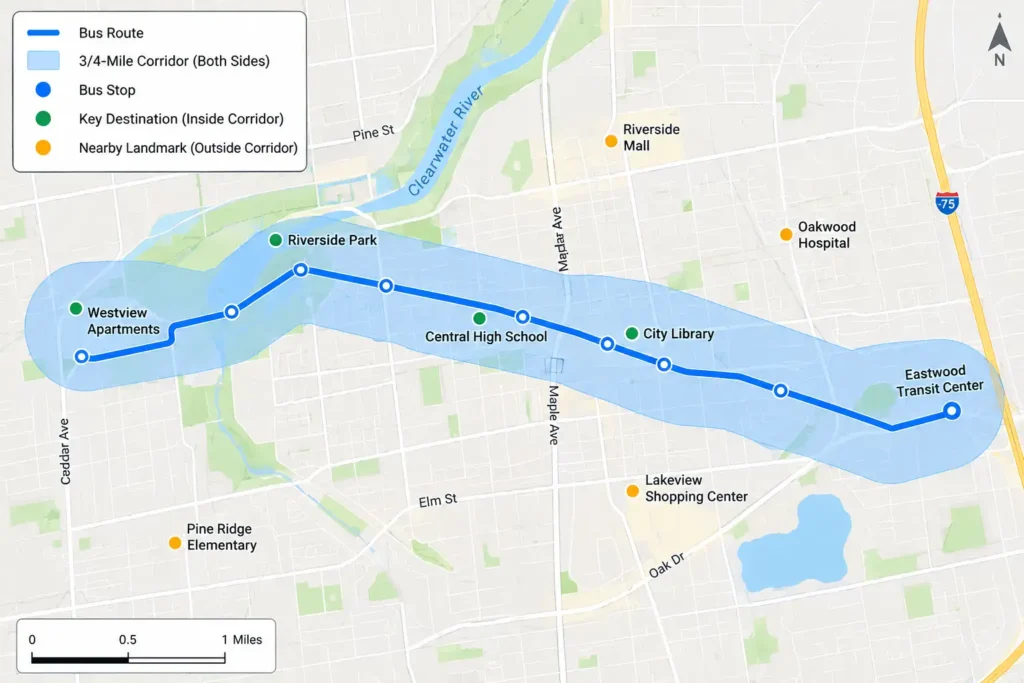
The core federal requirement covers trips that begin and end within three-quarters of a mile of a fixed bus route or rail station. Service must run during the same days and hours as the regular system. Some agencies go beyond this minimum, but they are not required to, and the extras can vary a lot from one region to the next.
Types of Paratransit Services
The word “paratransit” gets used loosely, so it helps to separate the main types:
- ADA complementary paratransit: The federally required service tied to fixed-route buses and rail, with the eligibility rules described above.
- Non-ADA demand-response service: Local programs, often for older adults or residents of a specific county, that may have different rules, longer service areas, or lower barriers to entry.
- Dial-a-ride and community shuttles: Small-vehicle services run by cities, counties, or nonprofits, sometimes open to the general public and sometimes limited to certain groups.
- Human-services transportation: Rides funded through social service programs, senior centers, or veterans’ programs for specific trip types.
- Contracted or hybrid models: Some agencies operate their own vans and also contract with private providers or adaptive rideshare companies to cover demand peaks.
If a friend says they “use paratransit,” ask which type. The rules for eligibility, cost, and trip length can vary widely among these.
What Is Paratransit? How It Works in Sacramento
In the Sacramento region, ADA paratransit is delivered through SacRT GO, the service run by Sacramento Regional Transit. Riders apply through the agency’s Accessible Services department, complete the eligibility process, and receive a decision letter. Once certified, they reserve trips by phone or through the agency’s booking tools, usually one to two days ahead.
Service follows the SacRT bus and light rail map. That means addresses within the three-quarter-mile corridor are covered, while areas outside it may not be. Some communities, such as Elk Grove, have separate local arrangements, so it is worth confirming your exact addresses with the agency before you count on a ride.
Local riders often run into the same practical questions: Does my doctor’s office fall inside the service area? Can I get home after a late afternoon procedure? What happens if my appointment runs long? Those questions are where private medical transportation often enters the picture.
For trips outside the corridor, on short notice, or with more hands-on help than a shared ride offers, many Sacramento families use a private provider. Riders in the southern part of the county often look at non-emergency medical transportation in Elk Grove because it covers local addresses and appointments with door-to-door help.
Similarly, families east of the city often ask about medical transportation in Rancho Cordova for clinic visits, therapy, and recurring treatments that fall between public service boundaries.
Paratransit vs. NEMT vs. Rideshare vs. Ambulance
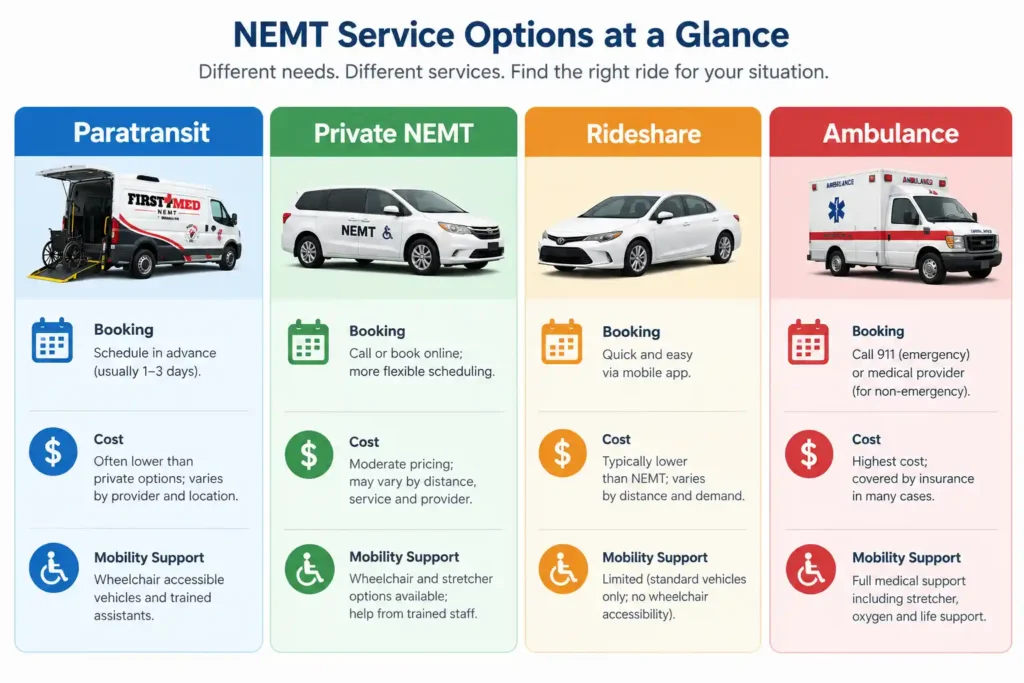
People often mix these services up because they all move someone from one place to another. The differences matter when you are choosing a ride for an appointment.
| Feature | ADA Paratransit | Private NEMT | Rideshare or Taxi | Ambulance |
| Who runs it | Public transit agency or its contractor | Private transportation company | Private app or taxi company | Emergency medical services |
| Eligibility | Must be certified under ADA rules | Appointment details and mobility needs; coverage varies | Open to the public | Medical emergency or clinical need |
| Booking | Reserve at least a day ahead | Call or online request; same-day may be possible | On-demand through an app | Call 911 |
| Service area | Typically within 3/4 mile of fixed routes | Broader, including long-distance trips | Wide, but limited accessible vehicles | Determined by dispatch |
| Ride type | Shared ride | Door-to-door, often dedicated to your trip | Standard vehicle, usually not accessible | Medically staffed transport |
| Mobility support | Wheelchair-accessible vehicles | Wheelchair, gurney, and ambulatory options | Limited or none | Full medical care |
| Cost | Fare capped at twice the local fixed-route fare | Insurance, Medi-Cal assistance, or private pay | Metered or dynamic pricing | Billed based on emergency response |
| Best for | Regular trips within the transit corridor | Appointments needing extra help or flexibility | Riders who can transfer into a standard car | True emergencies |
The short version: paratransit is a public accessibility service, NEMT is a scheduled medical ride with hands-on assistance, and an ambulance is for emergencies. Choosing the wrong one wastes money, time, or both.
Where Paratransit Falls Short
Paratransit does a lot of good, and it also has real limits that riders should know about before depending on it.
- Advance booking: Next-day scheduling does not help when a specialist calls with an opening tomorrow morning or a hospital discharge happens on short notice.
- Shared rides: Stops for other riders can extend travel time, which is hard on someone who tires easily or needs to reach a treatment on schedule.
- Pickup windows: A negotiated window of an hour before or after your requested time can clash with a strict appointment slot.
- Service boundaries: If your home or clinic sits outside the corridor, the ADA does not guarantee service.
- Eligibility hurdles: The application takes time, and some people with real mobility challenges may not qualify if they can technically use the fixed-route system on some days.
- Limited help inside buildings: Standard paratransit is usually curb-to-curb or door-to-door, and extra help through a lobby or clinic corridor is not always part of the service.
None of these points are complaints about agencies. They come from the way the federal framework is designed, and they are exactly why many riders use paratransit for some trips and a private option for others.
When a Private Medical Ride Is the Better Fit
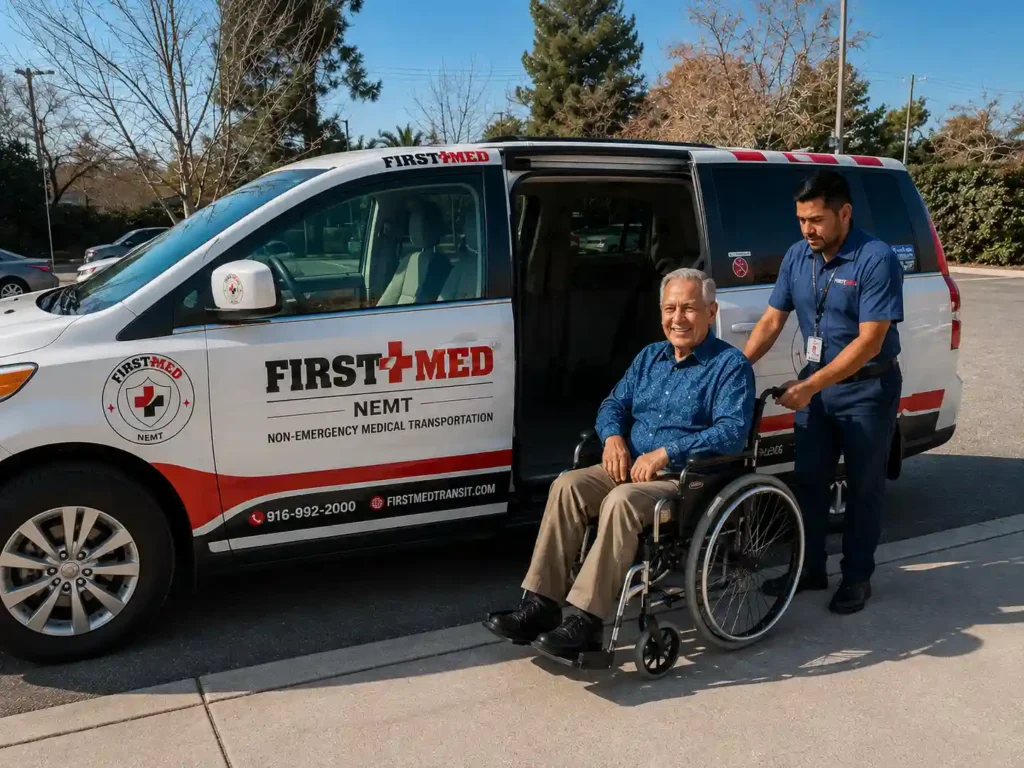
Private non-emergency medical transportation fills the gaps described above. Providers in this category are built around appointments and mobility needs rather than the transit map. That usually means dedicated vehicles, drivers trained in assisted boarding, and support that continues into the building.
First Med Transit, for example, provides non-emergency medical transportation across greater Sacramento and the Central Valley for wheelchair, gurney, and ambulatory trips, with drivers who hold first aid and CPR certifications. Requests are confirmed with trip details up front, and coverage questions, including Medi-Cal, are handled through the team.
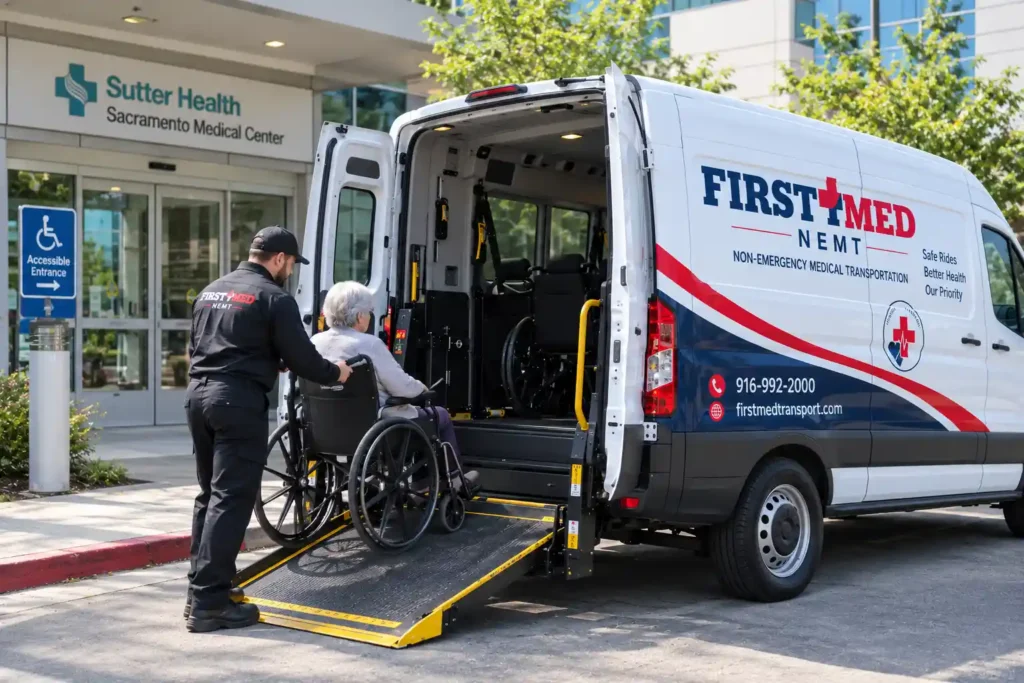
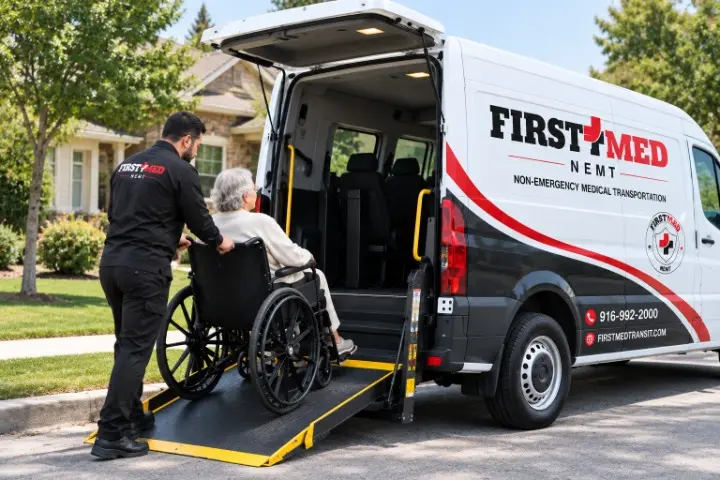
Riders who stay in their own chair through the whole trip often prefer wheelchair transportation in a lift-equipped or ramp-equipped van, since it removes the transfer into a car seat and back out again.
Older adults with fluctuating energy or balance challenges may prefer senior transportation where the driver walks them from the front door to the destination entrance and offers extra help inside if needed.
Last-minute needs are another common reason to look beyond paratransit. When a specialist opens an urgent slot or a hospital confirms a discharge for the same day, same-day NEMT can help bridge the gap, subject to availability.
And when the destination is far from home, such as a specialty clinic in another city, long-distance medical transportation can cover trips beyond the local service area. First Med Transit notes that it can accommodate long trips from Sacramento up to 500 miles.
Medi-Cal, Insurance, and Who Pays
Paying for transportation depends on the type of ride and your coverage. Here is how the pieces usually fit together:
- Paratransit fares are set by the transit agency and capped by federal rules. Riders pay the fare themselves unless another program subsidizes it.
- Medi-Cal NEMT is generally available for members who cannot use public or private transportation to reach covered services and who have a written order from a licensed provider. Managed care plans handle requests for their members.
- Medi-Cal non-medical transportation is a separate benefit for people who have no other way to reach covered appointments in a private or public vehicle.
- Other insurance plans may include transportation benefits for medically necessary trips, and the details vary by plan.
- Private pay is an option for trips that fall outside any covered category, such as social outings, errands, or extra-long travel.
Because rules change and plans differ, call your plan’s member services line and ask specifically about NEMT and non-medical transportation. A good private provider can also help you sort out what is likely to be covered before your first ride.
Read About: What to do if you have no one to drive you home from the hospital?
Practical Tips Before You Book Any Ride
These steps save time and prevent last-minute scrambling:
- Write down your regular trips. List destinations, days, and typical appointment lengths so you can see which trips fit paratransit and which do not.
- Check the map first. Ask the transit agency whether your home and each regular destination sit inside the service area.
- Start the application early. Certification can take weeks, so do not wait until the week of a major procedure.
- Ask a health professional to help with the verification section. Clear, specific descriptions of your functional limits make the process smoother.
- Plan for pickup windows. Request a ride time that leaves a comfortable buffer before your appointment.
- Keep a backup option. Save a private transportation number for days when paratransit cannot accommodate your schedule.
- Tell every provider about your equipment. Power chairs, scooters, oxygen equipment, and bariatric needs all affect vehicle choice.
- Ask the practical version of “what is paratransit?” for your address. The useful question is which of your regular trips fall inside the service area, at what times, and at what cost.
- Confirm who helps once you arrive. Ask whether the driver will help through the entrance, the lobby, or the waiting room.
Frequently Asked Questions
How does paratransit work?
Paratransit works as a reservation-based, shared-ride service. You apply and get certified, book a trip at least a day ahead, and a vehicle picks you up at or near your door and drops you at your destination within the service area.
Who qualifies for ADA paratransit?
Riders qualify when a disability prevents them from independently using the regular bus or rail system, whether by preventing them from reaching a stop, boarding and riding, or navigating the trip. Age, distance, or weather alone do not establish eligibility.
How much does paratransit cost?
Federal rules cap ADA paratransit fares at no more than twice the fixed-route fare for a similar trip. Many agencies charge a flat fare, and personal care attendants ride free. Check your local agency for current amounts.
Is paratransit the same as non-emergency medical transportation?
No. Paratransit is a public accessibility service tied to the local transit system. Non-emergency medical transportation is a scheduled ride, usually from a private provider, designed to get people to medical appointments with hands-on assistance and a wider set of vehicle types.
Can I use paratransit for non-medical trips?
Yes. ADA paratransit cannot restrict trips by purpose, so errands, work, social visits, and medical appointments are all treated equally, as long as the trip falls within the service area and hours.
What if paratransit cannot cover my appointment time?
Contact the agency to request a different pickup window, and line up a backup. Private NEMT providers, including those offering same-day rides, can help when timing or location falls outside paratransit limits.
Does Medi-Cal cover wheelchair van rides?
Medi-Cal covers non-emergency medical transportation, including wheelchair van service, for members who cannot use public or private transportation to reach covered services, generally with a written order from a licensed provider. Your health plan can confirm how to request
Can a caregiver or family member ride with me?
Personal care attendants ride free on ADA paratransit. Agencies must also allow at least one companion at the standard fare when space is available. Private providers set their own policies, so ask when you book.
Choosing the Right Ride for the Trip You Have
Paratransit is a valuable public service. It gives people with disabilities a way to reach work, family, and healthcare when regular transit is out of reach. It works best for routine trips inside the transit corridor, planned at least a day ahead.
Medical appointments, though, often demand more flexibility, more assistance, or a wider reach than the ADA minimums provide. Combining paratransit for predictable trips with a private provider for the rest is the setup many households settle on.
If you need help arranging a wheelchair, gurney, or ambulatory ride in Sacramento or the Central Valley, First Med Transit can walk you through your options, confirm trip details, and explain how coverage questions like Medi-Cal work. Call the team or submit a trip request through the website to get your next appointment on the calendar with a ride you can count on.