Being discharged from a hospital can bring a huge sense of relief, but it can also create an immediate practical problem: What to do if you have no one to drive you home from the hospital?
You may live alone, have family members who work during the day, have friends who live too far away, or simply have no one available when the hospital says you are ready to leave. If you are recovering from a procedure, using a wheelchair, feeling weak, or unable to drive yourself, arranging transportation becomes even more important.
The good news is that you do have options.
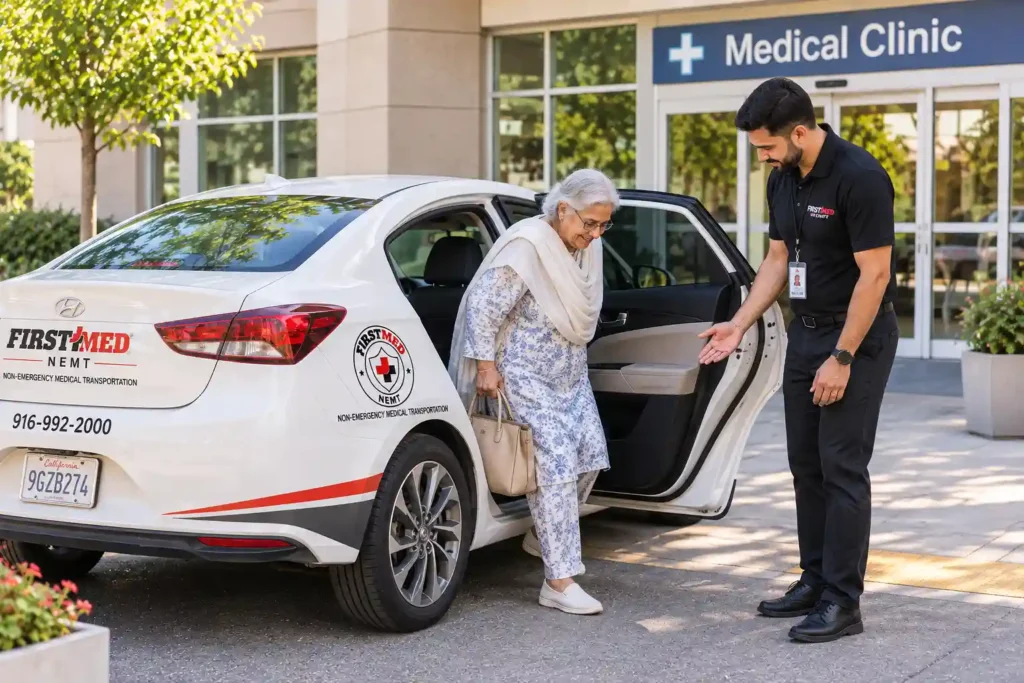
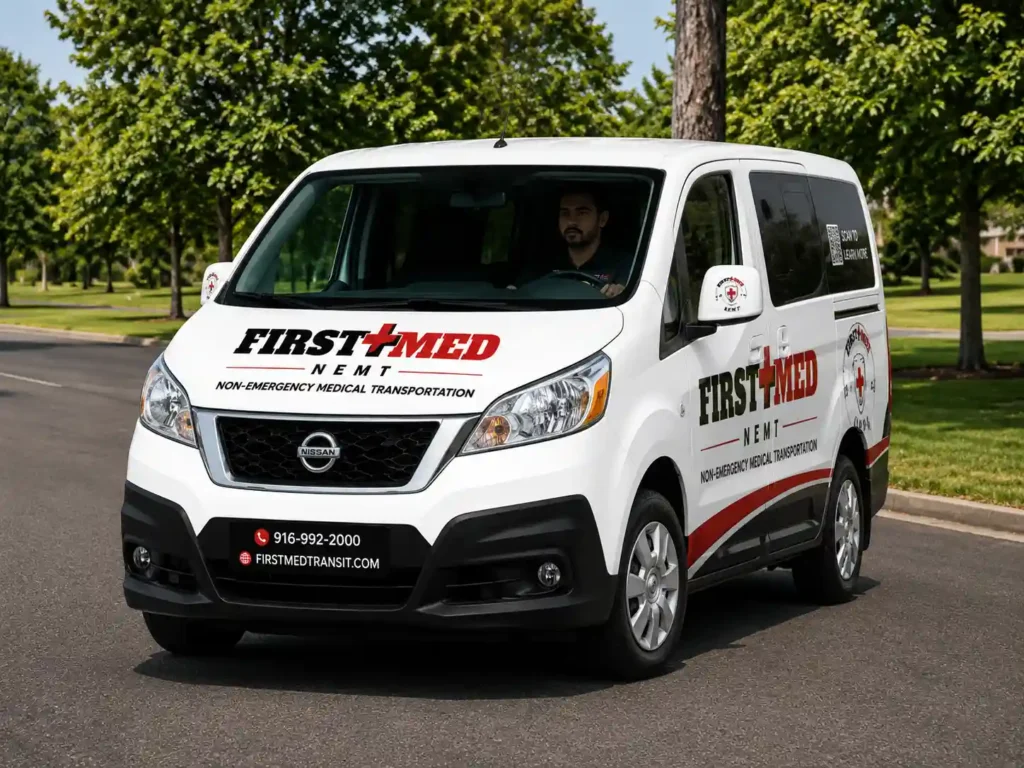
For a non-emergency hospital discharge, non-emergency medical transportation (NEMT) can provide a planned ride from the hospital to your home, rehabilitation facility, assisted living community, or another approved destination. Depending on your mobility needs, transportation may be available by ambulatory vehicle, wheelchair-accessible van, or stretcher-equipped vehicle.
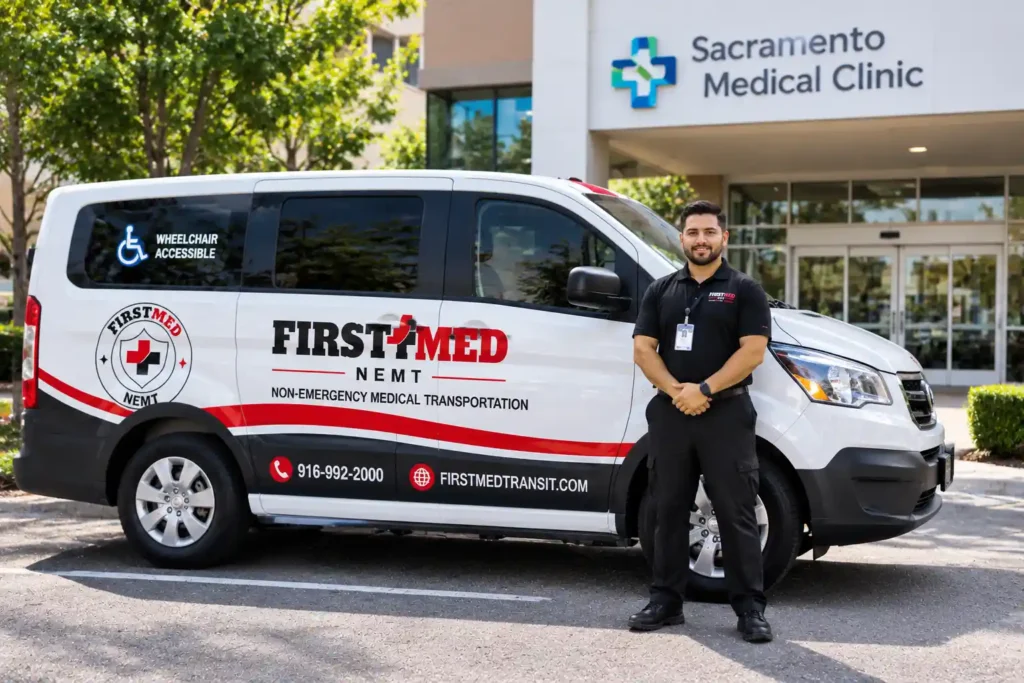
If you are in the Sacramento area, FirstMed Transit provides hospital-to-home and hospital discharge transportation designed around these situations.
What to do if you have no one to drive you home from the hospital?
The first step is to tell the hospital staff that you do not have transportation arranged.
Ask your nurse, discharge coordinator, social worker, case manager, or another member of the discharge team what transportation options are available. Hospitals regularly coordinate discharges, and the discharge team may be able to help you identify transportation providers or determine what type of ride is appropriate.
If you already know that you will need transportation, do not wait until the last few minutes if you can avoid it. Start arranging your ride as soon as you know you are likely to be discharged.
For Sacramento-area residents, professional NEMT can be an option when a regular car, taxi, or rideshare is not appropriate. FirstMed Transit offers hospital-to-home transportation using ambulatory, wheelchair, and stretcher-capable transportation depending on mobility requirements.
The basic process is:
- Tell hospital staff that you do not have a ride.
- Ask whether the hospital has a preferred transportation provider.
- Determine what type of transportation you need.
- Contact an NEMT provider and provide your hospital and destination information.
- Confirm the pickup location and expected discharge window.
- Confirm the cost or insurance arrangement before the ride.
- Make sure the transportation provider knows about any wheelchair, walker, stretcher, or transfer requirements.
Why arranging transportation before discharge matters
Hospital discharge timing can change. You may be told that you will leave in the afternoon, but the exact time may depend on paperwork, prescriptions, final instructions, transportation orders, or other discharge steps.
That is why communication is important.
A professional transportation provider can coordinate the pickup window with hospital staff rather than treating the trip like an ordinary taxi ride. FirstMed Transit specifically describes hospital discharge transportation as a service that can coordinate with discharge staff and provide different vehicle options based on mobility requirements.
Your main options when you have no ride home
Not every transportation option is appropriate after a hospital stay. The right choice depends on your mobility, discharge instructions, whether you can safely sit upright, whether you need assistance boarding, and whether the trip is an emergency.
| Transportation option | Best suited for | Mobility assistance | Wheelchair/stretcher capability |
| Family or friend | Someone who can safely travel in a regular vehicle | Depends on driver | Usually limited |
| Taxi | Independent traveler with minimal assistance | Limited | Usually no |
| Rideshare | Independent traveler who can enter and exit without assistance | Generally limited | Depends on service and vehicle |
| Ambulatory NEMT | Someone who can walk but needs transportation assistance | Yes | No stretcher |
| Wheelchair NEMT | Someone traveling in a wheelchair | Yes | Wheelchair accessible |
| Gurney/stretcher NEMT | Someone who cannot safely sit upright | Yes | Stretcher capable |
| Ambulance | Emergency or medically necessary ambulance transport | Medical emergency support | Yes |
The important distinction is that NEMT fills the space between ordinary transportation and emergency ambulance transportation. It is intended for planned healthcare-related travel when emergency response is not required.
If you are experiencing a medical emergency, call 911 rather than arranging NEMT. FirstMed Transit also states that its services are non-emergency transportation and directs people to 911 for emergencies.
Why a regular taxi or rideshare may not be the right choice
A standard rideshare or taxi can be convenient when someone can walk normally, get into a vehicle independently, sit safely, and manage their belongings without assistance.
A hospital discharge can be different.
After a procedure or hospital stay, you may have:
- Reduced strength
- Difficulty walking
- A wheelchair
- A walker or other mobility equipment
- Difficulty getting into a standard vehicle
- Restrictions on driving
- Difficulty climbing stairs
- A need for assistance from the hospital entrance to the vehicle
- A need to remain lying down during transportation
A standard rideshare driver generally is not equipped to provide the same type of mobility support as a specialized NEMT provider.
For example, wheelchair transportation requires appropriate vehicle access and securement systems. Stretcher transportation requires an entirely different vehicle and handling process. FirstMed Transit provides these different transportation levels through its Sacramento services.
Ask the hospital discharge team these questions
If you are still at the hospital and do not have transportation, asking the right questions can make the process much easier.
1. Am I cleared to leave?
Transportation should be arranged around the hospital’s discharge decision and instructions.
2. What type of transportation do I need?
Ask whether you can travel in a regular seated vehicle or whether you need ambulatory, wheelchair, or stretcher transportation.
3. Does the hospital have transportation providers it works with?
Some hospitals have preferred vendors, transportation coordinators, or discharge planning procedures.
4. Can the social worker or discharge coordinator help arrange the ride?
If you have no family or friends available, explain the situation clearly. Hospital staff may be able to help identify transportation resources.
5. Where should the driver pick me up?
Hospitals can have several entrances, emergency department entrances, loading areas, and discharge locations. Confirm the exact pickup point.
6. What time should the transportation provider arrive?
If discharge timing is uncertain, give the transportation company the expected window and update them when the hospital confirms the release time.
7. Do I need someone with me after I arrive home?
This is separate from transportation. A driver can provide transportation assistance, but the hospital may have separate instructions about supervision, recovery, medication, or staying with someone after discharge.
That last question is especially important after procedures involving sedation or anesthesia. A transportation company cannot replace a required responsible adult or in-home support person if the healthcare facility specifically requires one.
Hospital discharge transportation can provide a direct ride home
Hospital discharge transportation is designed specifically for the transition from a hospital to another destination.
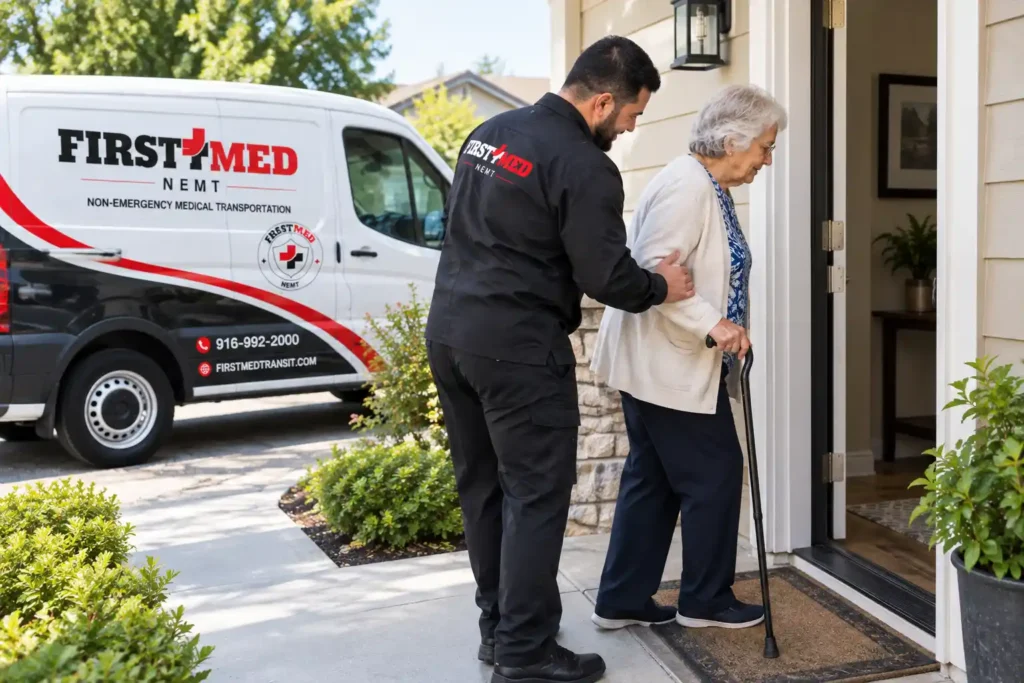
With Hospital To Home Transportation Services, the transportation provider can coordinate the pickup, match the vehicle to the mobility requirement, assist with boarding, and provide transportation to the destination. FirstMed Transit describes its hospital-to-home process as including transportation planning, coordination with discharge staff, pickup assistance, the ride home, and door-to-door arrival assistance.
This can be especially useful if you:
- Live alone
- Do not have nearby family
- Have family members who cannot leave work
- Do not have access to a vehicle
- Cannot safely drive
- Use a wheelchair
- Need assistance getting into a vehicle
- Need stretcher transportation
- Are returning to a rehabilitation facility
- Are moving from a hospital to another care setting
The transportation company should know whether your destination is a private residence, assisted living community, rehabilitation facility, skilled nursing facility, or another approved location.
What type of transportation do you need?
Choosing the right vehicle is one of the most important parts of arranging a safe discharge ride.
Ambulatory transportation
Ambulatory transportation may be appropriate if you can walk independently or with limited assistance and can safely sit in a vehicle.
You may still need transportation because you cannot drive yourself, do not have a vehicle, or need help getting from the hospital entrance to the vehicle.
FirstMed Transit provides Ambulatory Transportation Sacramento for people who can walk independently or with light assistance and need dependable transportation to healthcare destinations.
Wheelchair transportation
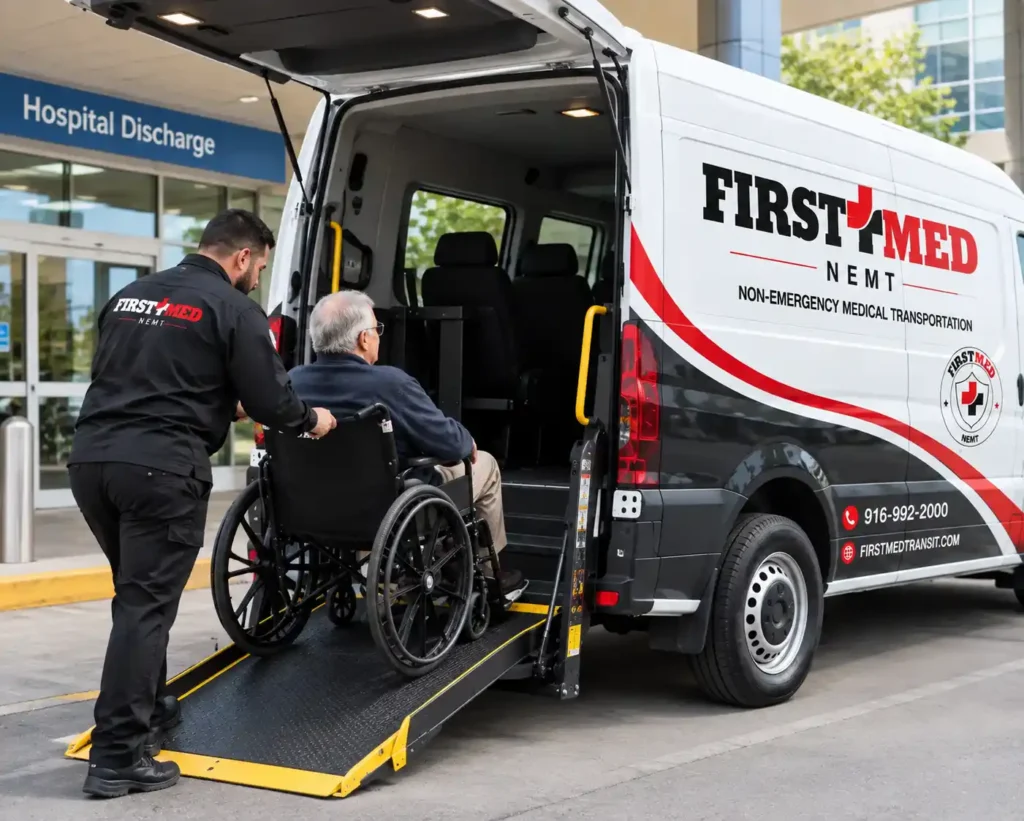
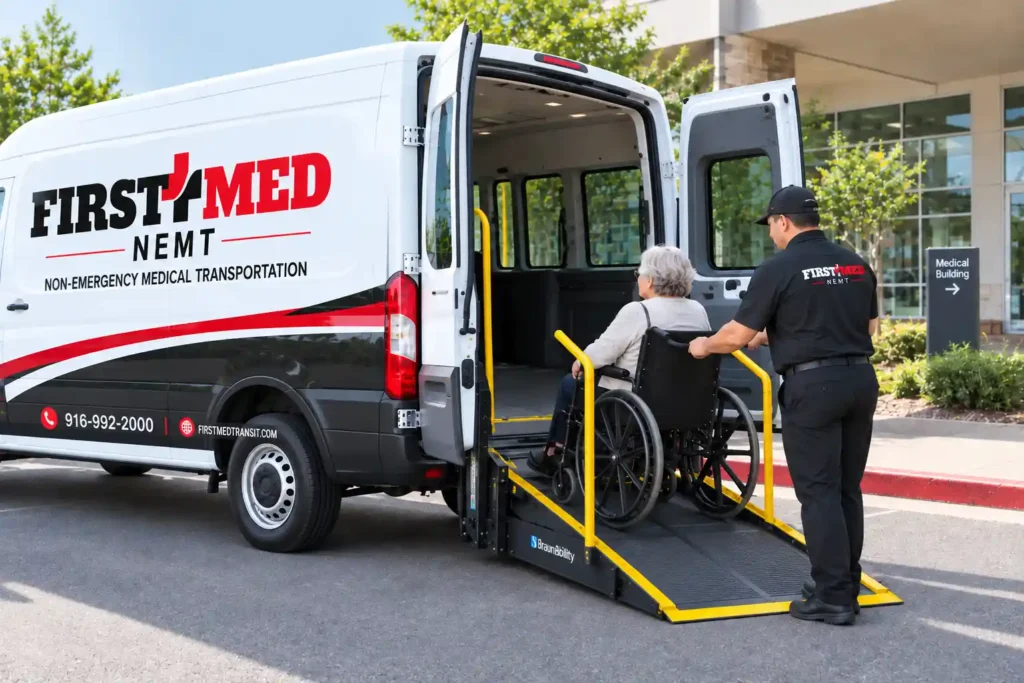
If you use a wheelchair and need to remain in it during transportation, a wheelchair-accessible vehicle may be more appropriate than a standard car.
A wheelchair-accessible vehicle can provide ramp or lift access and wheelchair securement equipment. FirstMed Transit provides wheelchair transportation for medical trips and hospital-related transportation throughout Sacramento.
Gurney or stretcher transportation
Some people cannot safely remain seated during transportation. In these situations, stretcher or gurney transportation may be necessary.
This type of transportation is different from a wheelchair van because the rider remains in a lying position during the trip. FirstMed Transit offers gurney transportation for hospital-to-home trips, facility transfers, and other non-emergency transportation needs.
What if you need transportation home the same day?
Sometimes discharge happens sooner than expected.
You may receive confirmation in the morning that you can leave later that day. A family member may be unavailable, or your original transportation plan may fall through.
In that situation, ask about same-day NEMT.
FirstMed Transit offers Same Day NEMT Sacramento for non-emergency transportation requests, including hospital discharges, specialist visits, dialysis, wheelchair transportation, ambulatory transportation, and stretcher transportation, subject to availability.
Same-day does not mean guaranteed immediate service. Availability depends on the provider’s vehicles, drivers, location, mobility requirements, and schedule.
When calling, explain that you are being discharged from a hospital and give the expected discharge time. That allows the transportation coordinator to determine whether an appropriate vehicle can be dispatched.
What information should you have ready when booking?
You can make the booking process faster by gathering the following information.
Hospital information
- Hospital name
- Hospital address
- Discharge department or pickup entrance
- Room or unit, if applicable
- Expected discharge time
- Hospital contact person, if available
Destination information
- Home address
- Apartment or building number
- Entry instructions
- Stairs or accessibility concerns
- Destination facility name if you are going somewhere other than home
Mobility information
Tell the transportation provider whether you:
- Walk independently
- Use a cane
- Use a walker
- Use a wheelchair
- Need assistance transferring
- Need a stretcher or gurney
- Need additional mobility equipment transported with you
You do not need to provide unnecessary private information. The transportation provider primarily needs enough information to select an appropriate vehicle and plan the trip safely.
Payment information
Be ready to discuss:
- Private pay
- Insurance transportation benefits
- Medi-Cal
- Authorization requirements
- Whether the trip is one-way or round trip
Providing complete information upfront helps avoid sending an unsuitable vehicle or creating delays at discharge.
Can Medi-Cal help if you have no transportation?
Potentially, yes.
California’s Department of Health Care Services states that Medi-Cal offers transportation to and from covered services. Medi-Cal distinguishes between Non-Medical Transportation, which can involve private or public transportation when someone does not have another way to reach a covered appointment, and Non-Emergency Medical Transportation for people who cannot use ordinary public or private transportation and need an appropriate medical transportation option.
For NEMT through Medi-Cal managed care, DHCS states that members should contact their health plan’s member services and that a prescription from a licensed healthcare provider is required. Requirements can vary depending on the transportation type and Medi-Cal arrangement.
That means you should not assume that every ride will automatically be covered.
Instead, ask:
- Does my Medi-Cal plan include transportation?
- Does my hospital discharge qualify?
- Do I need a prescription or authorization?
- Does the transportation provider participate with my plan?
- What information does the plan need?
- Is there any out-of-pocket cost?
FirstMed Transit has an existing page covering Sacramento Medi-Cal transportation and insurance verification assistance.
If you have private insurance or a Medicare Advantage plan, coverage also varies by plan. Verify the transportation benefit before assuming the ride will be covered.
How much does hospital discharge transportation cost?
There is no single price for hospital-to-home transportation.
The cost can vary according to distance, vehicle type, assistance requirements, scheduling, waiting time, and payment method.
FirstMed Transit’s Sacramento pricing guide gives general private-pay industry ranges rather than fixed FirstMed rates. It identifies local one-way NEMT trips as commonly falling within a broad range depending on whether the ride is ambulatory, wheelchair, or gurney transportation.
| Transportation type | General industry range for local one-way trips* | Why cost varies |
| Ambulatory | About $50–$120 | Distance, assistance, scheduling |
| Wheelchair | About $70–$180 | Accessible vehicle, distance, assistance |
| Gurney/stretcher | About $150–$300+ | Specialized equipment and handling |
| Long-distance | About $300–$1,500+ | Mileage, duration, vehicle and staffing |
*These are general industry ranges published by FirstMed Transit for informational purposes, not guaranteed FirstMed Transit prices. Get a trip-specific quote before booking.
Questions to ask about the price
Before confirming a private-pay ride, ask:
- Is the quoted price one-way or round trip?
- Does it include hospital pickup?
- Is door-to-door assistance included?
- Is waiting time included?
- Is there an additional charge if discharge is delayed?
- Is wheelchair or stretcher transportation priced differently?
- Are there after-hours charges?
- Does insurance or Medi-Cal cover any part of the trip?
For more detail about transportation pricing, you can link naturally to the existing FirstMed Transit pricing guide.
Learn About : How Medical Appointment Transportation Works in Sacramento?
How to prepare for the ride home
Getting transportation arranged is only part of a smooth discharge.
Before leaving the hospital, make sure you understand the instructions you have been given.
Confirm your destination
Tell the transportation provider exactly where you are going.
If you are going home, confirm the full address and any building or gate instructions.
Make sure the entrance is accessible
If you use a wheelchair or walker, identify the easiest entrance.
If there are stairs, narrow hallways, elevators, gates, or other access concerns, mention them during booking.
Have your discharge paperwork ready
Keep your discharge paperwork and instructions with you.
Ask the healthcare team to explain anything you do not understand before leaving.
Confirm medications and prescriptions
Make sure you understand what you are supposed to take and whether prescriptions need to be collected before going home.
Know your follow-up schedule
Write down the date, time, and location of your next appointment.
If you expect to need transportation again, ask about arranging the next ride before you leave.
Tell the driver about mobility limitations
Do not try to prove that you can walk farther or move faster than you safely can.
If you need assistance, tell the transportation team. The correct vehicle and appropriate planning are much safer than trying to improvise at the hospital entrance.
Can someone else arrange the ride for you?
Yes, transportation does not necessarily have to be booked personally.
A family member, caregiver, healthcare coordinator, or hospital staff member may be able to contact the transportation provider on your behalf.
FirstMed Transit states that care coordinators and family members can book transportation on behalf of a rider.
This can be particularly useful when you are still at the hospital and do not feel comfortable managing phone calls, paperwork, or transportation details yourself.
If someone else is booking the ride, make sure they have accurate information about:
- Your hospital
- Expected discharge time
- Destination
- Mobility level
- Wheelchair or stretcher requirements
- Insurance information
- Contact details
What if you live alone?
Living alone does not automatically mean you cannot return home after a hospital stay.
However, transportation and at-home support are two different issues.
A transportation provider can help you get from the hospital to your home. That does not necessarily mean someone will stay with you after arrival.
Before discharge, ask your healthcare team whether you need:
- Someone to stay with you
- Help with medications
- Help getting around the home
- Assistance with meals
- Help using stairs
- Home health services
- Durable medical equipment
- Follow-up care
- A temporary rehabilitation setting
If your healthcare team believes returning directly home is not appropriate, ask whether another discharge destination is recommended.
The transportation plan should follow the discharge plan, not replace it.
When should you arrange hospital discharge transportation?
The earlier you can arrange the ride, the better.
If you know a discharge is planned for a particular day, contact the transportation provider in advance. Give them the expected discharge time, then update the pickup window when the hospital confirms the exact timing.
For planned transportation, advance notice can make it easier to secure the right vehicle and driver.
FirstMed Transit recommends advance scheduling for many transportation needs, while also offering same-day transportation depending on availability.
If discharge has already been confirmed and you need a ride today, call rather than waiting for an online response.
What if your discharge time keeps changing?
Hospital discharge times are not always predictable.
Paperwork may take longer than expected. Prescriptions may need to be filled. A healthcare professional may need to complete a final assessment.
If the transportation provider is already scheduled, keep them informed.
Do not simply assume the driver will wait indefinitely.
Ask the transportation coordinator:
- How long can the vehicle wait?
- Should the pickup time be changed?
- What happens if discharge is delayed?
- Is there a waiting-time charge?
- What is the best way to communicate a change?
Clear communication can prevent a missed pickup or unnecessary waiting charge.
What if you have no car, no family, and no money for transportation?
Start by telling the hospital discharge team exactly what is happening.
Do not simply say, “I need a ride.”
Explain that you have no available driver and ask whether a social worker, case manager, or discharge coordinator can help identify transportation resources.
If you have Medi-Cal, contact your plan’s member services and ask about transportation benefits. California DHCS specifically recognizes transportation benefits for eligible Medi-Cal members who have transportation barriers.
If insurance does not cover the ride, ask transportation providers for a private-pay quote before confirming service.
You may also ask whether a lower level of transportation is safe and appropriate. For example, someone who can walk safely may not need wheelchair or stretcher transportation.
The key is to match the transportation level to the actual mobility requirement rather than automatically selecting the most expensive option.
Related: Does Medicare Cover Wheelchair Transportation?
What makes hospital discharge transportation different from ordinary medical rides?
A routine appointment usually has a predictable pickup time.
Hospital discharge can be less predictable.
The rider may be leaving after a procedure, may have new mobility limitations, may be using equipment they did not need before, or may need help moving from the discharge area to the vehicle.
That makes coordination particularly important.
FirstMed Transit describes hospital discharge transportation as including hospital pickup, mobility assistance, accessible transportation, and transportation directly to the home or another destination.
The service can also be useful when the destination is:
- A private residence
- Rehabilitation facility
- Skilled nursing facility
- Assisted living community
- Another healthcare facility
- A recovery location approved as part of the discharge plan
A simple hospital discharge transportation checklist
Use this checklist before leaving the hospital:
Before discharge
☐ Tell the hospital that you have no ride home.
☐ Ask for help from the discharge coordinator or social worker if needed.
☐ Confirm whether you can travel by regular vehicle or need specialized transportation.
☐ Contact an NEMT provider.
☐ Provide the hospital name and pickup location.
☐ Provide your destination address.
☐ Explain whether you walk, use a wheelchair, use a walker, or require stretcher transportation.
☐ Confirm the expected pickup time.
☐ Ask about insurance, Medi-Cal, or private-pay options.
☐ Confirm the estimated cost.
Before getting into the vehicle
☐ Confirm that the driver has the correct destination.
☐ Make sure your mobility equipment is secure.
☐ Keep discharge paperwork with you.
☐ Confirm that any required belongings, medications, and equipment are with you.
After arriving home
☐ Follow your discharge instructions.
☐ Make sure you have access to the support or equipment recommended by your healthcare team.
☐ Know when your next appointment is scheduled.
☐ Arrange future transportation early if another appointment is coming up.
Related resource: getting home after a medical procedure
Hospital discharge is not the only time people discover that they need a transportation plan.
Some outpatient procedures can also involve sedation, anesthesia, mobility restrictions, or facility-specific transportation rules. FirstMed Transit has a related article that explains how to arrange transportation after a medical procedure and what information to consider before booking.
Frequently Asked Questions
Can I get a ride home from the hospital if I have no family nearby?
Yes. Non-emergency medical transportation can be an option when you have been cleared for discharge but do not have a family member or friend available to drive you. Contact the hospital discharge team and an NEMT provider as early as possible.
Can a hospital arrange transportation home?
Hospital transportation policies vary. A hospital may have discharge coordinators, social workers, case managers, or preferred transportation resources that can help you arrange a ride. Ask the hospital staff what options are available.
Can I use Uber or Lyft after hospital discharge?
It depends on your situation and the discharge instructions. If you can safely enter and exit a standard vehicle and do not require mobility assistance, a regular rideshare may be possible in some situations. However, rideshare services are not a substitute for specialized NEMT when you need wheelchair, stretcher, or transfer assistance.
What is NEMT hospital discharge transportation?
NEMT hospital discharge transportation is a scheduled, non-emergency transportation service that moves someone from a hospital to home or another approved destination after discharge. Depending on mobility needs, transportation may be ambulatory, wheelchair accessible, or stretcher capable.
Can I get wheelchair transportation from the hospital to my home?
Yes. Wheelchair-accessible NEMT can provide transportation for someone who needs to remain in a wheelchair during the trip. FirstMed Transit provides wheelchair transportation throughout Sacramento and surrounding communities.
What if I cannot sit upright after leaving the hospital?
Ask the hospital team whether stretcher or gurney transportation is appropriate. FirstMed Transit provides gurney transportation for non-emergency hospital-to-home trips when someone needs to remain in a lying position during transportation.
Can I arrange transportation on the same day as discharge?
Sometimes. Same-day NEMT depends on vehicle and driver availability, location, mobility requirements, and timing. FirstMed Transit offers same-day NEMT in Sacramento and recommends calling directly when transportation is needed quickly.
Can someone else book my transportation?
Yes. A family member, caregiver, care coordinator, or hospital staff member may be able to arrange the ride on your behalf. FirstMed Transit states that family members and care coordinators can book transportation for a rider.
Does Medi-Cal cover transportation home from a hospital?
Coverage depends on the transportation type, eligibility, plan, and applicable requirements. California DHCS states that Medi-Cal offers transportation benefits for covered services and distinguishes between NMT and NEMT. NEMT can require a prescription from a licensed healthcare provider and plan coordination.
How much does hospital discharge transportation cost?
There is no universal price. Cost depends on distance, vehicle type, assistance level, scheduling, waiting time, and payment arrangement. Private-pay industry ranges can vary significantly between ambulatory, wheelchair, and stretcher transportation. Ask for a trip-specific quote before booking.
Can medical transportation take me directly inside my home?
Door-to-door assistance may be available depending on the transportation provider and your circumstances. FirstMed Transit describes its hospital-to-home service as providing assistance through arrival at the destination. Confirm the exact level of assistance when booking.
What information should I provide when arranging the ride?
Have the hospital name, pickup location, expected discharge time, destination address, mobility requirements, equipment needs, and payment or insurance information ready. This allows the transportation company to select an appropriate vehicle and coordinate the pickup.
Plan the ride before you leave the hospital
If you are facing discharge and have no one available to drive you home, you are not limited to waiting for a family member to become available.
Start with the hospital’s discharge team. Explain that you have no transportation and ask what resources are available. Then contact an appropriate NEMT provider and explain exactly what type of assistance you need.
For Sacramento residents, FirstMed Transit provides hospital-to-home, hospital discharge, wheelchair, ambulatory, gurney, and same-day NEMT options. The company serves Sacramento and surrounding communities and can coordinate transportation based on the rider’s mobility needs.
The most important thing is to choose transportation that matches your actual needs.
If you can walk safely, ambulatory transportation may be enough. If you use a wheelchair, request wheelchair-accessible transportation. If you cannot sit upright, ask about stretcher or gurney transportation. If the situation is an emergency, call 911 rather than arranging non-emergency transportation.
For hospital discharge transportation in Sacramento, contact FirstMed Transit to discuss your hospital, destination, discharge timing, mobility needs, and available transportation options.