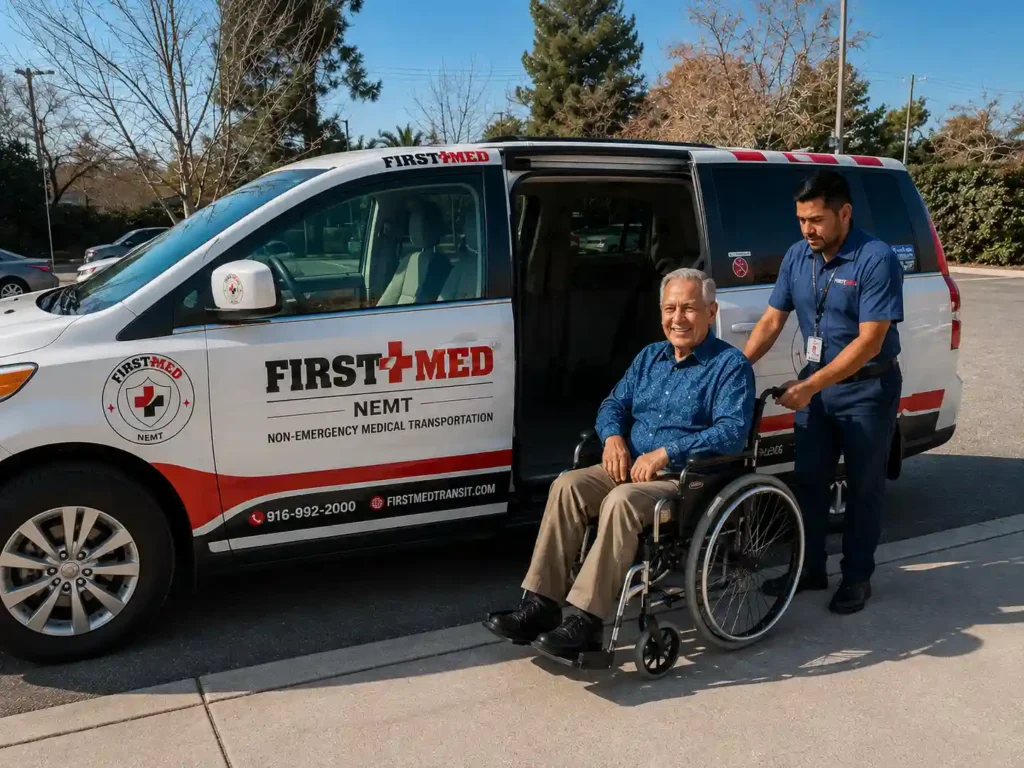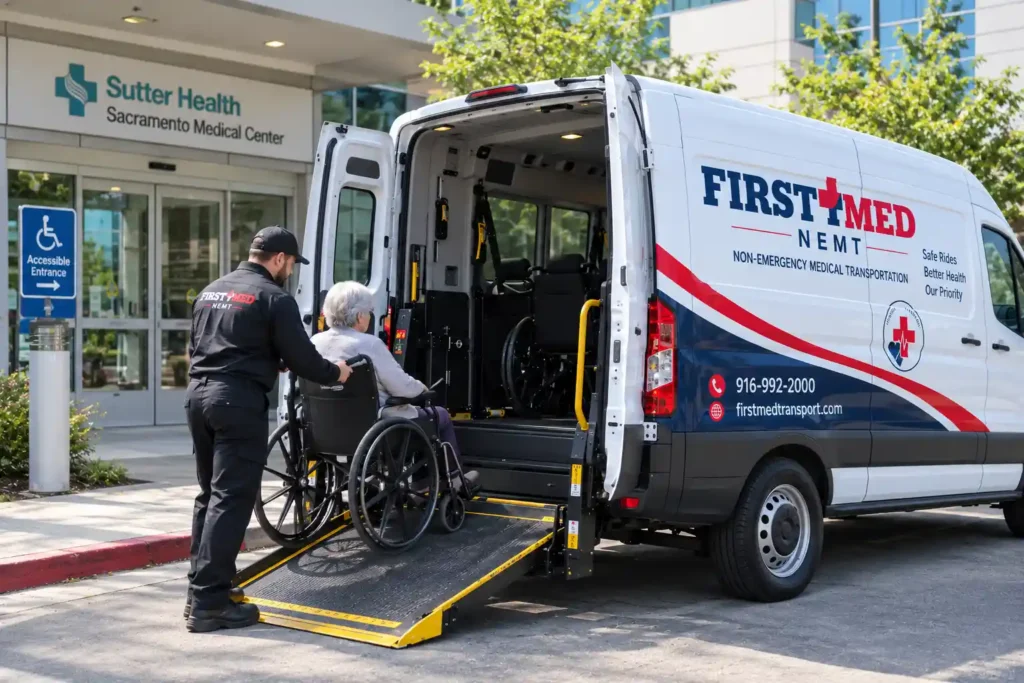
If you have ever searched for a reliable way to get to a medical appointment, dialysis treatment, hospital discharge, therapy session, or other healthcare destination, you may have come across the term NEMT.
So, what is NEMT transportation?
NEMT stands for Non-Emergency Medical Transportation. It is transportation designed for people who need help getting to or from healthcare services but do not require emergency medical care or an ambulance.
NEMT can range from ambulatory transportation for someone who can walk and sit normally to wheelchair-accessible transportation and stretcher or gurney transportation for people with greater mobility needs.
The Federal Transit Administration describes NEMT as transportation that helps people access medical and healthcare services, particularly those who may otherwise have difficulty reaching regular healthcare.
In Sacramento, FirstMed Transit provides NEMT services for medical appointments, dialysis, hospital discharge, wheelchair transportation, ambulatory transportation, senior transportation, and other scheduled healthcare trips.
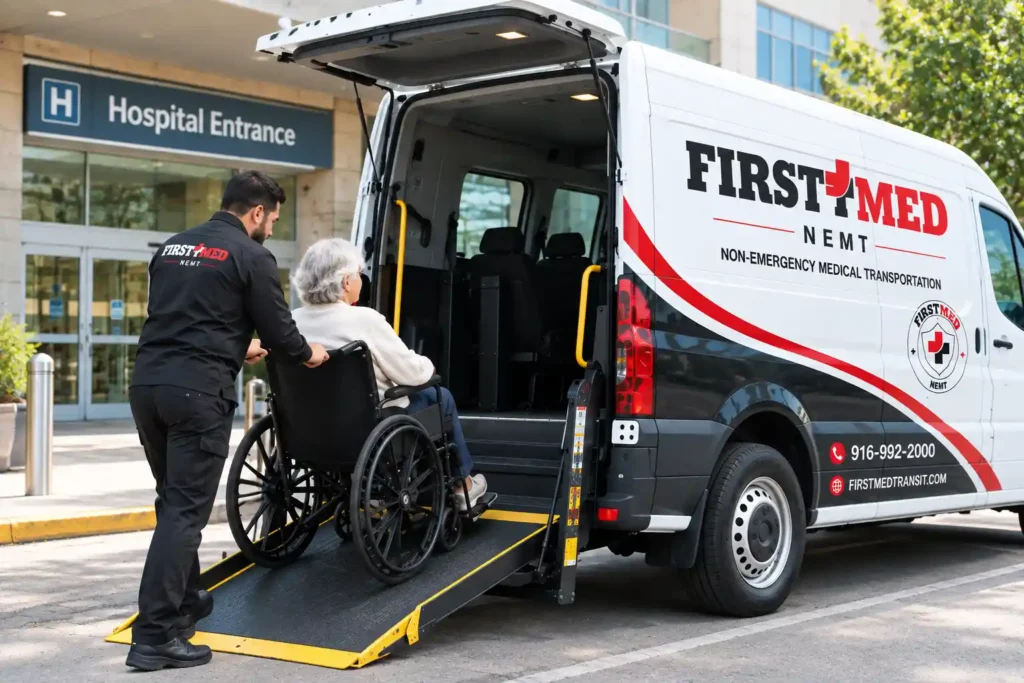
What is NEMT transportation?
What is NEMT transportation? NEMT is scheduled transportation for healthcare-related trips when a person does not need emergency medical transportation but cannot reasonably use ordinary transportation for the trip.
Depending on the person’s mobility and transportation needs, NEMT may involve:
- Ambulatory transportation
- Wheelchair-accessible transportation
- Gurney or stretcher transportation
- Hospital discharge transportation
- Transportation to medical appointments
- Dialysis transportation
- Transportation to therapy and rehabilitation
- Senior transportation
- Transportation to specialty clinics
- Recurring healthcare transportation
The exact definition and eligibility requirements can vary depending on the state, health plan, and payment arrangement. For Medi-Cal in California, the Department of Health Care Services defines NEMT as transportation by ambulance, wheelchair van, or litter van for eligible members who cannot use public or private transportation and need assistance with ambulation.
That is different from simply ordering a regular taxi or rideshare.
NEMT exists to address transportation barriers that make ordinary transportation unsuitable or impractical for a healthcare-related trip.
How does non-emergency medical transportation work?
NEMT generally works through a scheduled transportation process.
A person, family member, caregiver, healthcare facility, or authorized coordinator arranges transportation with a provider or transportation program. The transportation provider then determines the appropriate vehicle and service based on the trip requirements.
A typical trip may follow these steps:
1. Transportation is requested
The rider or someone assisting them provides:
- Pickup location
- Destination
- Date
- Appointment or discharge time
- Return-trip requirements
- Mobility information
- Wheelchair or stretcher requirements
- Insurance or payment information, when applicable
2. Transportation needs are reviewed
The provider determines what type of vehicle is appropriate.
For example, someone who can walk and sit upright may need ambulatory transportation, while someone who travels in a wheelchair may require an accessible van.
3. The ride is scheduled
The transportation company confirms the pickup time and trip details.
For recurring services such as dialysis or regular therapy, transportation may be arranged as a repeating schedule.
4. The driver arrives
The driver arrives at the designated pickup location and provides the level of assistance included with the service.
5. The rider travels to the healthcare destination
The driver transports the rider to the appointment, facility, hospital, treatment center, or other scheduled destination.
6. The return trip is completed
If transportation has been booked as a round trip, the provider coordinates the return journey based on the appointment or facility schedule.
FirstMed Transit describes its Sacramento NEMT services as including wheelchair, ambulatory, and stretcher transportation for healthcare appointments, dialysis, follow-up visits, and ongoing healthcare needs.
Who uses NEMT services?
NEMT is not limited to one age group or one type of healthcare visit.
People may need non-emergency medical transportation because they:
- No longer drive
- Do not have access to a vehicle
- Cannot safely use public transportation
- Use a wheelchair
- Have difficulty walking
- Need assistance getting into or out of a vehicle
- Need transportation after a hospital discharge
- Attend recurring dialysis treatments
- Need regular therapy transportation
- Have mobility limitations
- Need a scheduled ride to a specialist
- Live alone without someone available to provide transportation
- Need transportation between healthcare facilities
Older adults and people with disabilities are among the groups that frequently rely on NEMT. The Federal Transit Administration notes that millions of Americans use NEMT to access medical services.
Seniors
Transportation can become a major concern when an older adult stops driving or has difficulty using ordinary transportation.
Professional senior transportation can provide scheduled rides to:
- Doctor appointments
- Specialist visits
- Hospitals
- Therapy
- Rehabilitation
- Dialysis
- Pharmacies
- Medical testing facilities
FirstMed Transit provides senior transportation throughout Sacramento and surrounding communities, including medical appointment and healthcare-related transportation.
People who use wheelchairs
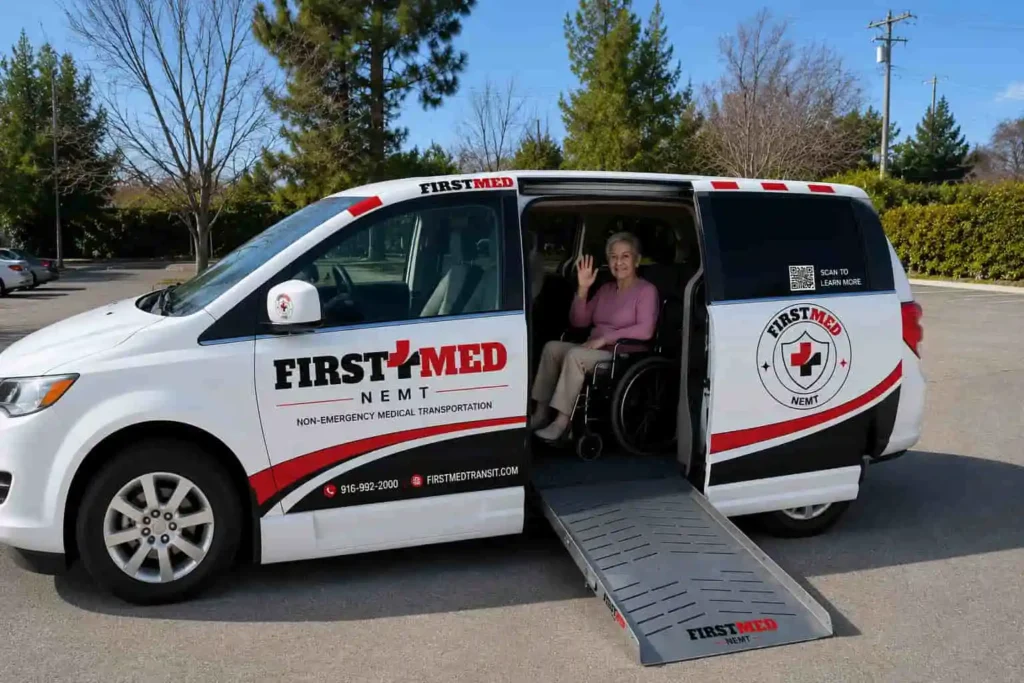
A standard car may not be suitable for someone who needs to remain in a wheelchair during transportation.
Wheelchair-accessible NEMT vehicles can include ramps or lifts and wheelchair securement equipment designed to keep the wheelchair properly positioned during the trip.
People who need stretcher transportation
Some riders cannot safely travel while seated.
A stretcher or gurney vehicle may be appropriate when the rider needs to remain in a lying or reclined position during transportation and the trip is non-emergency.
FirstMed Transit provides gurney transportation for healthcare appointments, facility transfers, hospital-related transportation, and other scheduled trips.
What types of NEMT transportation are available?
NEMT is not one single type of vehicle.
The appropriate transportation depends on mobility, accessibility, the destination, and the requirements of the trip.
| NEMT type | Generally appropriate for | Common trips |
| Ambulatory transportation | People who can walk and sit upright | Doctor visits, specialist appointments, therapy |
| Wheelchair transportation | People who travel using a wheelchair | Medical appointments, hospital discharge, dialysis |
| Gurney/stretcher transportation | People who cannot safely travel seated | Hospital discharge, facility transfers, scheduled medical trips |
| Hospital discharge transportation | People leaving a hospital for home or another facility | Hospital-to-home, rehab, assisted living |
| Dialysis transportation | People attending recurring dialysis treatments | Regular dialysis sessions |
| Senior transportation | Older adults who need dependable transportation | Healthcare visits, therapy, pharmacies |
The important point is that NEMT should be matched to the rider’s actual transportation needs rather than simply selecting the most basic or most specialized option.
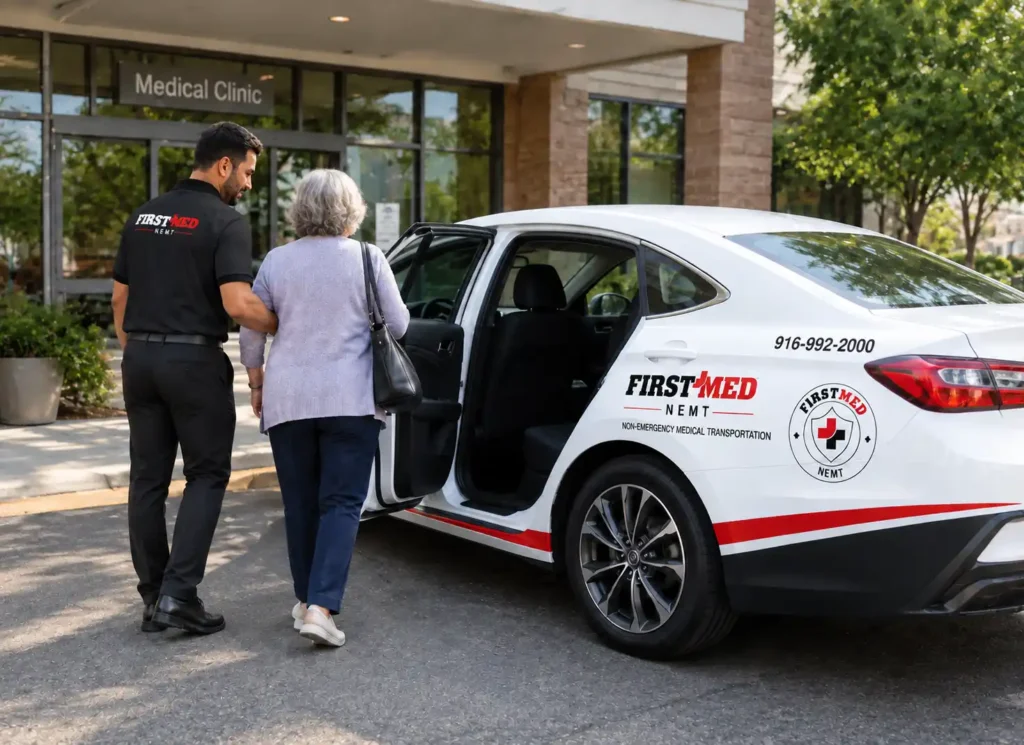
What is ambulatory NEMT?
Ambulatory transportation is designed for people who can walk independently or with limited assistance and can safely sit in a vehicle.
You may need ambulatory transportation even if you do not use a wheelchair.
For example, someone may be able to walk but still:
- Be unable to drive
- Need help getting from a home entrance to a vehicle
- Have difficulty using public transportation
- Need a reliable scheduled ride
- Need assistance getting into or out of the vehicle
FirstMed Transit has a dedicated guide explaining ambulatory transportation and how it differs from wheelchair and stretcher services.
What is wheelchair NEMT?
Wheelchair NEMT is transportation using an accessible vehicle that allows a wheelchair user to travel safely.
Depending on the vehicle and rider’s requirements, accessibility may include:
- Ramp access
- Lift access
- Wheelchair securement systems
- Adequate interior space
- Boarding assistance
- Driver support during entry and exit
Wheelchair transportation can be used for medical appointments, dialysis, hospital discharge, therapy, rehabilitation, and other healthcare-related trips.
FirstMed Transit provides wheelchair transportation in Sacramento using accessible vehicles for scheduled healthcare transportation.
What is gurney or stretcher NEMT?
Gurney transportation, also called stretcher transportation, is designed for non-emergency trips when someone cannot safely remain seated during the journey.
This can be relevant for:
- Hospital-to-home transportation
- Facility-to-facility transfers
- Rehabilitation transportation
- Certain medical appointments
- Recurring treatment
- Dialysis transportation when seated transport is not appropriate
Gurney transportation is not the same as ambulance transportation.
An ambulance is designed and equipped for emergency or medically necessary ambulance transport. Gurney NEMT is intended for scheduled, non-emergency transportation.
If there is an emergency, call 911 rather than arranging NEMT.
NEMT vs. Ambulance: What is the difference?
This is one of the most important distinctions to understand.
NEMT is for scheduled, non-emergency transportation.
An ambulance is intended for emergency response or situations requiring ambulance-level transportation and medical support.
| NEMT | Ambulance |
| Scheduled transportation | Emergency or medically necessary ambulance transportation |
| Healthcare appointments | Emergency medical situations |
| Dialysis | 911 response |
| Hospital discharge | Emergency department response |
| Therapy and rehabilitation | Medical emergencies |
| Wheelchair transportation | Ambulance-level medical transport |
| Ambulatory transportation | Emergency transport |
| Gurney transportation for non-emergency trips | Emergency stretcher transport |
NEMT providers do not replace emergency medical services.
FirstMed Transit specifically states that its services are non-emergency and that people experiencing emergencies should call 911.
When should you call 911 instead?
Call 911 if the situation involves an emergency such as:
- Severe breathing difficulty
- Uncontrolled bleeding
- Loss of consciousness
- A serious injury
- A suspected life-threatening condition
- Another situation requiring immediate emergency response
Do not delay emergency care while trying to arrange a scheduled transportation service.
NEMT for medical appointments
Medical appointment transportation is one of the most common NEMT uses.
Transportation may be arranged for:
- Primary care appointments
- Specialist visits
- Follow-up appointments
- Dental appointments
- Diagnostic testing
- Imaging
- Outpatient procedures
- Therapy
- Rehabilitation
- Dialysis
- Radiation therapy
- Hospital visits
Reliable transportation can be especially important when appointments occur regularly.
FirstMed Transit provides transportation to hospitals, dialysis centers, rehabilitation facilities, specialty clinics, therapy centers, and medical and dental appointments throughout the Sacramento region.
NEMT for dialysis
Dialysis transportation is a particularly important use of NEMT because dialysis schedules are often recurring.
Someone may need transportation several times each week, making reliability and scheduling extremely important.
Depending on mobility, transportation may be:
- Ambulatory
- Wheelchair accessible
- Stretcher or gurney capable
FirstMed Transit provides recurring dialysis transportation in Sacramento and can arrange transportation around established treatment schedules.
Recurring transportation can reduce the need to arrange every trip separately and can help families and caregivers plan around a consistent schedule.
NEMT for hospital discharge
Another major use of NEMT is transportation after a hospital stay.
Someone may be medically cleared to leave the hospital but still be unable to drive or use a regular car.
Hospital discharge transportation can provide a planned trip from:
- Hospital to home
- Hospital to rehabilitation facility
- Hospital to skilled nursing facility
- Hospital to assisted living community
- Hospital to another healthcare facility
FirstMed Transit provides hospital discharge transportation throughout Sacramento and coordinates pickup details with hospitals, caregivers, and families when required.
For people who need accessible transportation after discharge, selecting the correct vehicle before leaving the hospital is especially important.
NEMT for seniors
Transportation can play an important role in helping older adults maintain access to regular healthcare.
A senior may stop driving because of mobility changes, difficulty managing traffic, lack of confidence, or another personal consideration.
NEMT can provide scheduled transportation to:
- Doctor appointments
- Specialists
- Dental appointments
- Therapy
- Dialysis
- Rehabilitation
- Hospitals
- Pharmacies
- Other healthcare destinations
FirstMed Transit provides senior transportation in Sacramento with ambulatory, assisted, and wheelchair transportation options.
NEMT for people with disabilities
People with disabilities may have transportation requirements that ordinary public transportation or standard vehicles cannot accommodate.
Accessible NEMT may help with:
- Wheelchair transportation
- Mobility assistance
- Accessible boarding
- Healthcare appointment transportation
- Therapy transportation
- Hospital transportation
- Recurring healthcare trips
FirstMed Transit also provides transportation for disabled adults for medical appointments, therapy, and other transportation needs.
What is the difference between NEMT and regular transportation?
The main difference is that NEMT is designed around healthcare-related transportation needs.
A normal transportation service primarily focuses on getting someone from one location to another.
NEMT considers additional factors such as:
- Mobility
- Accessibility
- Wheelchair requirements
- Stretcher requirements
- Healthcare destinations
- Appointment timing
- Hospital discharge coordination
- Recurring treatment schedules
That does not mean every NEMT trip requires specialized equipment.
Someone who can walk normally may still benefit from ambulatory NEMT because they need reliable transportation for a healthcare-related trip.
NEMT vs. rideshare and taxi services
A taxi or rideshare may work for someone who can independently enter and exit a standard vehicle.
However, it may not be appropriate when someone needs specialized mobility assistance.
| Feature | Regular taxi/rideshare | NEMT |
| Scheduled healthcare trips | Sometimes | Yes |
| Wheelchair-accessible options | Limited/varies | Available through specialized providers |
| Stretcher transportation | No | Available through qualified providers |
| Hospital discharge | Possible but limited | Common NEMT use |
| Recurring dialysis | Not designed specifically for it | Common use |
| Mobility-focused assistance | Limited | Depending on provider/service |
| Healthcare transportation specialization | No | Yes |
The exact features vary by provider, so always ask what is included before booking.
Is NEMT covered by Medi-Cal?
For eligible California Medi-Cal members, NEMT can be a covered transportation benefit when the applicable requirements are met.
California’s Department of Health Care Services explains that NEMT is available when a person’s medical or physical condition prevents them from using ordinary public or private transportation. DHCS also states that NEMT services require a healthcare provider prescription.
Medi-Cal transportation should not be confused with Non-Medical Transportation, or NMT.
NEMT vs. NMT
NEMT is intended for people whose medical or physical condition means ordinary transportation is not suitable.
NMT generally refers to transportation to and from covered services for eligible members who can use ordinary transportation.
California DHCS distinguishes these two categories and provides different eligibility requirements.
This distinction matters when arranging transportation through Medi-Cal.
If you have Medi-Cal, contact your health plan or transportation coordinator to determine:
- Whether you qualify
- Whether the trip is covered
- Whether a healthcare provider prescription is required
- Whether prior authorization is needed
- Which transportation providers are available
- Whether there is any cost to you
FirstMed Transit has a dedicated Sacramento Medi-Cal transportation page explaining its transportation and insurance support.
How much does NEMT cost?
NEMT pricing varies significantly.
There is no universal national price because transportation providers use different pricing structures and the cost depends on factors such as:
- Mileage
- Vehicle type
- Trip duration
- Wheelchair requirements
- Stretcher requirements
- Wait time
- One-way or round-trip service
- Same-day scheduling
- Long-distance travel
- Insurance or Medi-Cal coverage
Private-pay NEMT may be priced differently from transportation arranged through a health plan.
For that reason, it is best to request a specific quote rather than relying on a general online estimate.
What should you ask before booking?
Ask:
- What is the total estimated cost?
- Is the quote one-way or round trip?
- Does the price include boarding assistance?
- Is waiting time included?
- Is there a fee for a delayed appointment?
- Does wheelchair or stretcher transportation cost more?
- Does insurance cover the trip?
- Is authorization required?
Getting these answers in advance helps avoid surprises.
Related: How Medical Appointment Transportation Works in Sacramento?
How do you schedule NEMT transportation?
Scheduling NEMT is usually straightforward.
Step 1: Identify your transportation needs
Know whether you need:
- Ambulatory transportation
- Wheelchair transportation
- Stretcher transportation
- Hospital discharge transportation
- Recurring transportation
Step 2: Gather trip information
Have your:
- Pickup address
- Destination
- Appointment date
- Appointment time
- Return time, if known
- Mobility information
- Insurance details
Step 3: Contact the provider
Call or submit a transportation request.
Explain exactly what assistance is required rather than simply saying that you need a medical ride.
Step 4: Confirm the vehicle
Make sure the transportation provider knows whether you use a wheelchair or need stretcher transportation.
Step 5: Confirm the booking
Confirm:
- Date
- Pickup time
- Pickup location
- Destination
- Vehicle type
- Return trip
- Payment or insurance arrangement
Step 6: Keep the provider informed
If your appointment time changes, tell the transportation company as soon as possible.
This is particularly important for hospital discharges and appointments that may run longer than expected.
Read About: Cost of Non Emergency Medical Transport
What information does an NEMT provider need?
A transportation company does not need every detail of your healthcare history to schedule a ride.
Usually, the most important information is transportation-related.
| Information | Why it matters |
| Pickup location | Helps the driver find you |
| Destination | Determines route and scheduling |
| Appointment time | Helps coordinate pickup |
| Mobility level | Determines appropriate vehicle |
| Wheelchair type | Helps determine accessibility requirements |
| Stretcher requirement | Determines vehicle type |
| Return-trip details | Helps coordinate the return |
| Insurance information | Helps determine billing or eligibility |
Be clear about mobility needs.
If you normally walk but will be using a wheelchair temporarily after a procedure, tell the transportation provider before the trip.
Can NEMT be scheduled for recurring appointments?
Yes.
Recurring transportation is one of the most useful features of NEMT for people who attend regular healthcare appointments.
Examples include:
- Dialysis
- Physical therapy
- Occupational therapy
- Rehabilitation
- Recurring specialist visits
- Radiation therapy
- Regular treatment appointments
Instead of arranging a completely new ride every time, recurring transportation can be scheduled around a consistent appointment pattern.
FirstMed Transit provides recurring transportation options for dialysis and other ongoing healthcare transportation needs.
What should you look for in an NEMT provider?
Choosing an NEMT provider should involve more than looking for the cheapest ride.
Consider the following:
1. Appropriate vehicles
Make sure the company offers the vehicle type you actually need.
2. Trained drivers
Ask whether drivers receive transportation and mobility-assistance training.
3. Accessibility
If you use a wheelchair, confirm that the vehicle can accommodate your wheelchair type.
4. Reliability
Ask how the provider handles scheduled pickup times and delays.
5. Service area
Make sure the provider serves both your pickup and destination.
6. Insurance and payment options
Ask whether the provider works with your health plan or offers private-pay transportation.
7. Recurring transportation
If you have regular appointments, ask whether standing or recurring transportation can be arranged.
8. Hospital coordination
For hospital discharge, ask whether the provider can coordinate with discharge staff.
FirstMed Transit describes its Sacramento NEMT services as using trained drivers and accessible vehicles for wheelchair, ambulatory, stretcher, dialysis, hospital discharge, and other healthcare transportation needs.
What happens during an NEMT ride?
A typical NEMT trip is designed to be predictable.
The driver arrives at the agreed pickup location, confirms the trip, provides the appropriate boarding assistance, and transports the rider to the scheduled destination.
Depending on the service, assistance may include:
- Getting into the vehicle
- Securing a wheelchair
- Boarding through a ramp or lift
- Helping with basic mobility during boarding
- Transporting the rider to the destination
- Assisting with arrival at the facility
The exact level of assistance varies by provider and service, so clarify expectations when booking.
NEMT is transportation, not emergency medical care. A driver should not be expected to provide emergency medical treatment during a routine trip.
Common healthcare destinations for NEMT
NEMT can be used for many healthcare-related destinations.
Hospitals
Transportation can be arranged for scheduled hospital visits, admissions, or discharge.
Doctor offices
Primary care and routine medical appointments are common NEMT trips.
Specialist clinics
Transportation may be arranged for specialty appointments.
Dialysis centers
Recurring dialysis transportation is a major use of NEMT.
Therapy centers
NEMT can support regular physical, occupational, and other therapy appointments.
Rehabilitation facilities
Transportation may be needed between home, rehabilitation facilities, and healthcare appointments.
Dental offices
Some transportation providers also offer rides to dental appointments.
Diagnostic centers
Transportation can be arranged for scheduled testing and imaging when ordinary transportation is not appropriate.
NEMT in Sacramento
For Sacramento residents, NEMT can provide transportation throughout Sacramento and nearby communities.
FirstMed Transit lists services for Sacramento and surrounding areas and provides transportation to hospitals, dialysis centers, rehabilitation facilities, specialty clinics, therapy centers, and medical and dental appointments.
Depending on the service and availability, transportation may be available in communities such as:
- Sacramento
- Elk Grove
- Rancho Cordova
- Folsom
- Roseville
- Rocklin
- Natomas
- Citrus Heights
- Surrounding Sacramento County communities
If your exact pickup or destination is outside the core service area, confirm availability before booking.
Practical tips for a smoother NEMT ride
A few simple steps can make transportation easier.
Book ahead when possible
Advance scheduling gives the transportation provider more time to assign the appropriate vehicle.
Give accurate mobility information
Do not underestimate or overestimate your transportation needs.
Confirm the pickup location
Hospitals and large medical facilities can have several entrances. Specify the correct pickup point.
Keep appointment information accessible
Have the appointment date, time, destination, and return requirements available.
Ask about return transportation
If the appointment duration is uncertain, ask how return transportation is handled.
Notify the provider about changes
If an appointment is canceled, delayed, or rescheduled, contact the transportation provider as soon as possible.
Ask questions about payment
Do not assume insurance or Medi-Cal automatically covers every trip. Verify the specific transportation benefit and requirements.
Frequently Asked Questions About NEMT
What does NEMT stand for?
NEMT stands for Non-Emergency Medical Transportation. It refers to transportation for healthcare-related trips when emergency ambulance transportation is not required.
What is NEMT transportation used for?
NEMT can be used for medical appointments, dialysis, therapy, rehabilitation, hospital discharge, specialist visits, dental appointments, and other scheduled healthcare trips.
Is NEMT the same as an ambulance?
No. NEMT is for scheduled, non-emergency transportation. An ambulance is intended for emergency response or situations requiring ambulance-level transportation.
Who can use NEMT?
Eligibility depends on the transportation program and payment source. People who may use NEMT include seniors, wheelchair users, people with mobility limitations, people without suitable transportation, and individuals attending recurring healthcare appointments.
Does Medi-Cal cover NEMT in California?
Eligible Medi-Cal members may qualify for NEMT when their medical or physical condition prevents them from using ordinary transportation and applicable requirements are met. California DHCS states that NEMT requires a healthcare provider prescription.
Is NEMT only for wheelchair users?
No. NEMT can include ambulatory transportation for people who can walk and sit upright, wheelchair transportation, and stretcher transportation depending on the rider’s needs.
Can NEMT take someone to dialysis?
Yes. Dialysis transportation is a common NEMT use, particularly for people who need recurring transportation several times per week.
Can NEMT take someone home after hospital discharge?
Yes. Hospital-to-home transportation is a common NEMT service when someone has been cleared for discharge but cannot or should not drive themselves.
Can NEMT be used for dental appointments?
Yes. Depending on the provider and transportation program, NEMT may be available for dental appointments and other covered healthcare services.
Can I schedule recurring NEMT?
Yes. Recurring transportation can be arranged for regular appointments such as dialysis, therapy, rehabilitation, and other ongoing healthcare services.
How far in advance should NEMT be scheduled?
The appropriate booking window depends on the provider, transportation type, health plan, and trip. Advance booking is generally preferable, especially when a wheelchair or stretcher vehicle is required.
Can someone else schedule my NEMT ride?
In many situations, a family member, caregiver, healthcare facility, or authorized coordinator can assist with arranging transportation. Confirm the provider’s booking requirements.
What if I need transportation today?
Some providers offer same-day NEMT depending on vehicle and driver availability. Contact the provider directly and explain the pickup time, destination, and transportation requirements.
FirstMed Transit offers same-day NEMT services in Sacramento when availability allows.
A quick guide to choosing the right NEMT service
If you are unsure which type of transportation you need, use this simple guide:
Can you walk and sit upright safely?
Ambulatory transportation may be appropriate.
Do you use a wheelchair during transportation?
Ask for wheelchair-accessible transportation.
Can you not safely remain seated?
Ask whether stretcher or gurney transportation is appropriate.
Are you leaving a hospital?
Ask about hospital discharge or hospital-to-home transportation.
Do you attend dialysis regularly?
Ask about recurring dialysis transportation.
Are you experiencing an emergency?
Call 911 instead of booking NEMT.
Why reliable NEMT matters
Transportation is more than simply moving from one address to another when healthcare is involved.
A missed appointment can disrupt an established schedule. Recurring treatment can become difficult to manage without dependable transportation. Families may struggle to take time away from work for every appointment. Older adults and people with mobility limitations may have fewer practical transportation options.
The Federal Transit Administration recognizes NEMT as an important way of connecting people with medical and healthcare services and notes that transportation barriers can contribute to delayed care.
That is why the right transportation service should focus on reliability, accessibility, scheduling, and the actual needs of the rider.