Choose gurney transport when a patient is medically stable but cannot sit upright, walk, or safely travel in a wheelchair and needs to remain lying down during transportation. Choose an ambulance when the patient has an emergency or requires medical monitoring, treatment, or life-support capabilities during the trip.
A gurney transport vehicle is designed for non-emergency medical transportation and safely moves stable patients on a stretcher between hospitals, rehabilitation centers, nursing facilities, medical appointments, or home. While the vehicle may look similar to an ambulance and both can transport patients horizontally, the key difference is the level of medical care provided. Ambulances are equipped and staffed to respond to emergencies, while gurney transport is intended for patients who need safe, comfortable transportation without emergency medical intervention. Understanding this difference can help you choose the right service, avoid unnecessary ambulance costs, and ensure your loved one receives the appropriate level of care for their condition.
This guide breaks down Gurney Transport vs Ambulance: What’s the Difference & Which Do You Need? in plain language, so you can make the right call the next time you’re standing in that hallway.
What Is an Ambulance, Exactly?
An ambulance is an emergency medical response vehicle. It’s staffed by EMTs or paramedics trained to treat life-threatening conditions in real time — chest pain, stroke symptoms, severe trauma, breathing failure. Ambulances carry advanced equipment: cardiac monitors, defibrillators, oxygen delivery systems, IV medications, and in many cases, the ability to intubate a patient or administer emergency drugs before they ever reach a hospital.
Ambulances are dispatched through 911, prioritized by urgency, and billed as emergency medical services. Their entire design — lights, sirens, right-of-way at intersections — exists to get a patient into treatment as fast as physically possible. That level of readiness comes at a cost. Emergency ambulance transport commonly runs anywhere from $500 to over $3,000 per trip depending on distance, region, and level of care provided, and insurance coverage for it varies significantly.
What Is Gurney Transport (Non-Emergency Medical Transportation)?
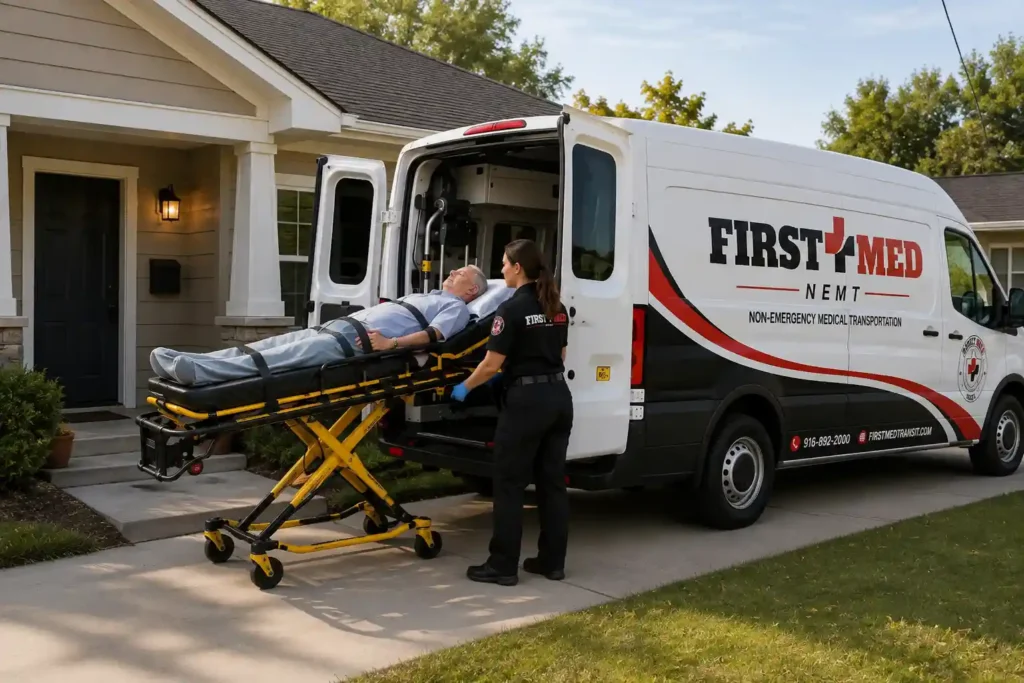
Gurney transport, sometimes called stretcher transport, is a category of non-emergency medical transportation (NEMT). It’s built for a very different situation: a patient who is medically stable — not in crisis — but who physically cannot sit upright or transfer into a regular vehicle seat. That includes people recovering from surgery, hospice patients being moved between facilities, individuals with severe mobility limitations, or someone being discharged after a procedure that requires them to stay horizontal.
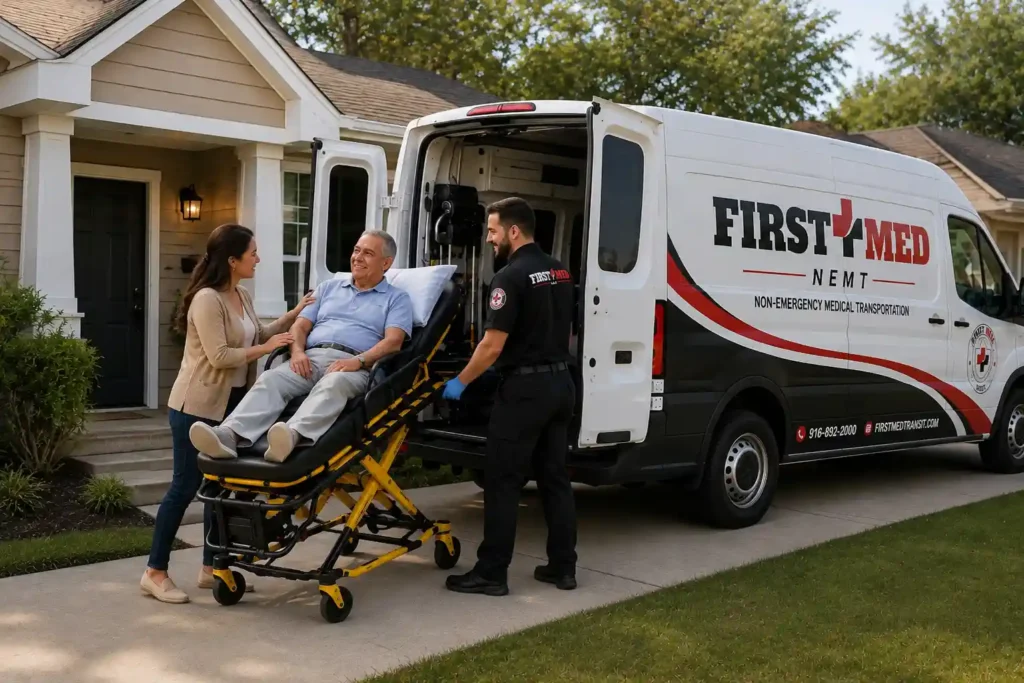
Gurney transport vehicles are vans or specially modified vehicles equipped with a securely mounted stretcher, safety restraints, and trained drivers often CPR and First Aid certified who know how to handle transfers safely and with dignity. What they don’t carry is emergency intervention equipment, and that’s by design. These trips are scheduled, not dispatched as emergencies, which is part of why they cost significantly less.
Our gurney transport service is built exactly around this need safe, scheduled, stretcher-based transport for patients who are stable but can’t sit upright.
For a deeper walkthrough of what a typical gurney transport trip looks like and what it costs, this is worth a read: our related post, What is Gurney Transportation? Costs and Benefits (A Sacramento Family’s Guide)
Gurney Transport vs Ambulance: What’s the Difference & Which Do You Need? Side-by-Side Comparison
The clearest way to see the differences is to line them up directly.
| Factor | Ambulance | Gurney Transport (NEMT) |
| Purpose | Emergency medical response | Scheduled, non-emergency transport |
| Patient condition | Unstable, life-threatening, or urgent | Medically stable, cannot sit upright |
| Staff | EMTs / Paramedics | Trained transport attendants, CPR/First Aid certified |
| On-board equipment | Cardiac monitors, defibrillator, IV meds, oxygen | Secured stretcher, basic first aid, restraints |
| Dispatch method | 911, prioritized by urgency | Scheduled call or online booking |
| Typical cost | 500–3,000+ per trip | Roughly 150–400+ depending on distance |
| Insurance handling | Billed as emergency medical service | Often covered by Medi-Cal/Medicaid with prior approval |
| Speed / urgency | Immediate, lights and sirens | Scheduled pickup window |
| Common use case | Heart attack, stroke, trauma, severe injury | Hospital discharge, dialysis, facility transfer, post-surgery |
Key Differences That Actually Matter for Your Decision
Medical urgency is the real dividing line. If someone’s condition could deteriorate in the next few minutes chest pain, difficulty breathing, uncontrolled bleeding, signs of stroke that’s an ambulance situation, full stop. Gurney transport is never appropriate for an active emergency because the vehicle and staff aren’t equipped to intervene medically.
Staffing reflects the mission. Paramedics train for years to manage crises. NEMT drivers train specifically in safe patient handling, transfers, and de-escalating the physical and emotional stress of transport — a different, equally important skill set, just not one built for medical intervention.
Cost difference is significant and often misunderstood. Families frequently call an ambulance for a stable discharge simply because they don’t know an alternative exists, then get hit with a bill that insurance may only partially cover. Understanding this distinction upfront can save real money.
Booking process is night and day. Ambulances are dispatched reactively through 911. Gurney transport is proactive you schedule it in advance for appointments, discharges, or transfers, which also means more predictable pricing and availability.
Our same-day NEMT service exists specifically for the moments when a discharge happens faster than expected and you need reliable transport without the emergency price tag.
When You Actually Need an Ambulance
Call 911 immediately if the person is experiencing:
- Chest pain, pressure, or suspected heart attack symptoms
- Signs of stroke (facial drooping, slurred speech, sudden weakness)
- Severe difficulty breathing
- Uncontrolled bleeding or major trauma
- Loss of consciousness or unresponsiveness
- Severe allergic reaction
There is no gray area here. If any of these apply, gurney transport is not a substitute, and no non-emergency provider should ever be used in place of an ambulance in a true emergency.
When Gurney Transport Is the Right Call
Gurney transport fits situations where the patient is stable but physically limited, such as:
- Hospital discharge when the patient can’t sit upright
- Transfers between hospitals, rehab centers, or skilled nursing facilities
- Post-surgical recovery trips home
- Recurring appointments for patients who must remain lying flat
- Hospice or palliative care transport
- Bariatric patients who need specialized handling
For patients transitioning out of the hospital specifically, our hospital discharge transport service is designed to coordinate directly with discharge planners so the ride is ready the moment you are.
Not every patient who needs a stretcher is in a medical facility setting either some are simply moving from hospital to home and need a smooth, well-coordinated handoff.
Cost Breakdown: What You Can Realistically Expect to Pay
| Trip Type | Estimated Cost Range | Notes |
| Local ambulance (non-critical) | 500–1,200 | Varies heavily by region and provider |
| Ambulance (advanced life support) | 1,200–3,000+ | Includes advanced monitoring/medication |
| Gurney transport, short distance | 150–300 | Within metro area |
| Gurney transport, long distance | 300–600+ | Between cities or regions |
| Wheelchair/ambulatory NEMT | 50–150 | For patients who don’t need a stretcher |
These figures are general industry ranges, not a quote — always confirm exact pricing directly with a provider before booking, since distance, mobility equipment, and insurance status all affect the final cost.
If your loved one doesn’t need a full stretcher but can’t safely walk or transfer alone, wheelchair transportation is often the more cost-effective option.
To understand exact pricing further, our related post, How Much Does a Wheelchair Transport Cost? A Complete Pricing Guide
Does Insurance or Medi-Cal Cover This?
This is usually the second question families ask, right after “which one do I need.” The honest answer: it depends on the service, the state, and the specific plan.
Ambulance transport for genuine emergencies is typically covered by insurance, though copays and out-of-network charges vary widely. Non-emergency gurney transport is often covered under Medi-Cal or Medicaid, but usually requires prior authorization and documentation from a physician confirming medical necessity.
We help eligible passengers navigate this directly through our Medi-Cal and insurance assistance, so coverage questions don’t turn into a billing surprise later.
For a full walkthrough of what’s typically covered and what isn’t, our related post, Does Insurance Cover Non-Emergency Medical Transportation?
For general Medicaid NEMT policy background, the Centers for Medicare & Medicaid Services (CMS) publishes official guidance on non-emergency medical transportation coverage that’s worth reviewing if you want the federal-level framework behind state programs like Medi-Cal.
Gurney Transport vs Ambulance: What’s the Difference & Which Do You Need? A Quick Decision Checklist
Ask these three questions in order:
- Is this a medical emergency right now? If yes, call 911. Stop reading and act.
- Can the patient safely sit upright and transfer into a seat? If yes, ambulatory or wheelchair transport may be enough.
- Is the patient stable but unable to sit upright? This is the gurney transport zone.
If you land on step three, you’re not dealing with an emergency, and you don’t need to pay emergency rates or wait for 911 dispatch priority.
For patients managing ongoing treatments who also need stretcher-level support, our dialysis transport and senior transport services are built around recurring, predictable scheduling rather than one-off emergency dispatch.
Regional and Long-Distance Considerations
Not every situation is a short trip across town. Facility transfers between cities, or moving a patient to be closer to family, require different planning than a local ambulance run ever would. For these situations, our long distance medical transportation service handles multi-hour trips with the same stretcher-level care and monitoring as a local transfer.
For visibility into vehicle standards behind any of these trips, the National Highway Traffic Safety Administration’s Office of EMS sets national benchmarks for ambulance and medical transport vehicle safety that reputable providers align with, even outside of emergency dispatch.
Frequently Asked Questions
Is gurney transport the same as an ambulance?
No. Gurney transport is non-emergency, scheduled transportation for medically stable patients who can’t sit upright. An ambulance is emergency response for patients in urgent or life-threatening condition, staffed by paramedics with advanced medical equipment.
Can I call a gurney transport service instead of 911 in an emergency?
No. Gurney transport vehicles and staff are not equipped or trained to handle emergencies. If there’s any doubt about medical urgency, call 911.
Why does gurney transport cost less than an ambulance?
Gurney transport doesn’t require the advanced life-support equipment, paramedic-level staffing, or emergency dispatch infrastructure that ambulances maintain, which is reflected in significantly lower per-trip pricing.
Does Medi-Cal cover gurney transport?
In many cases, yes, when a physician documents medical necessity and prior authorization is obtained. Coverage details vary, so it’s worth confirming directly with your provider before scheduling.
What’s the difference between gurney transport and wheelchair transport?
Gurney transport is for patients who must remain lying flat. Wheelchair transport is for patients who can sit upright but can’t walk or transfer independently. They’re priced differently and use different vehicle setups.
How far in advance should I book gurney transport?
Advance booking is ideal for planned discharges or recurring appointments, but same-day service is often available for unexpected discharges or urgent (non-emergency) needs.
Is gurney transport safe for post-surgical patients?
Yes, when handled by trained staff using properly secured, hospital-grade stretcher systems. This is one of the most common reasons families choose gurney transport over other options.
Making the Right Call, Not Just the Fast One
The instinct to call 911 comes from a good place nobody wants to make the wrong decision when a loved one’s safety is on the line. But understanding the real difference between gurney transport and an ambulance means you can make a faster, calmer, and more financially sound decision the next time you’re standing in that hospital hallway.
If your situation is urgent, call 911 without hesitation. If it’s not, and you just need safe, scheduled, stretcher-level transport, our team is ready to help.
Contact Us to schedule gurney transport or ask questions about which service fits your situation.