
If you’ve ever had a doctor recommend regular dialysis sessions, physical therapy, or radiation treatment and then realized getting there is its own challenge, you’re not alone. One of the first questions almost every patient or caregiver asks is simple: does insurance actually cover non-emergency medical transportation? The honest answer is that it depends heavily on which type of insurance you have, where you live, and what kind of appointment you’re traveling to. This guide breaks down exactly what different insurance types cover, what they don’t, and what your realistic options look like when coverage falls short.
What Is Non-Emergency Medical Transportation, Exactly?
Non-emergency medical transportation, often shortened to NEMT, refers to transportation arranged specifically for people who need help getting to and from medical appointments but don’t require an ambulance or emergency response. This covers a wide range of situations: a wheelchair user heading to a specialist appointment, a senior citizen without a driver’s license going to a routine checkup, or someone recovering from surgery who can’t safely drive themselves home from the hospital.
The confusion around insurance coverage usually comes from the fact that NEMT sits in a strange middle ground. It’s clearly medical in nature, but it’s also transportation, which most people associate with out-of-pocket costs like a taxi or rideshare. Insurance providers have had to develop specific policies to address this gap, and those policies vary enormously depending on the type of coverage involved.
Medicaid and Medi-Cal Coverage for Non-Emergency Medical Transportation
Medicaid, known as Medi-Cal in California, is generally the most reliable source of NEMT coverage for eligible patients. Federal Medicaid rules actually require states to provide transportation to and from covered medical services when a beneficiary has no other means of getting there, which makes this one of the few areas where transportation coverage isn’t just a nice-to-have benefit but a federal requirement.
How Medi-Cal NEMT Coverage Works
Medi-Cal covers non-emergency medical transportation for recipients who meet specific medical necessity criteria, which typically means a physician or other qualified provider has documented that the patient cannot safely travel to appointments using regular transportation methods. This might apply to patients who:
- Use a wheelchair and need a vehicle equipped to transport them safely
- Require a gurney due to their medical condition
- Have a condition that makes standing, walking, or sitting upright for extended periods difficult
- Need medical monitoring or assistance during transport
Coverage typically extends to appointments like dialysis treatment, cancer treatment including radiation therapy, physical therapy, specialist visits, and hospital discharge transportation. If you’re managing recurring appointments like dialysis, understanding this coverage can make a significant financial difference, since dialysis transport Sacramento costs add up quickly without insurance support.
Getting Medi-Cal Transportation Approved
The process usually starts with your doctor completing a certification form indicating why non-emergency medical transportation is necessary for your specific situation. This isn’t automatic. Even with Medi-Cal coverage, you generally need this documentation on file before a ride will be authorized, so it’s worth having this conversation with your provider well before your appointment date rather than the day before.
Getting your physician’s documentation in order early is one of the most overlooked steps in this whole process. Patients often assume coverage is automatic once they’re enrolled in Medi-Cal, only to discover at the last minute that they need a specific form signed first.
Medicare Coverage for Non-Emergency Medical Transportation
Medicare coverage for NEMT is more complicated than Medicaid because it depends heavily on which type of Medicare you have.
Original Medicare (Parts A and B)
Original Medicare’s coverage for non-emergency medical transportation is quite limited. Generally, Original Medicare covers ambulance transportation only when it’s medically necessary and typically tied to emergency situations, or specific non-emergency scenarios where a doctor certifies that ambulance transport is the only safe option. Standard non-emergency rides in a regular NEMT vehicle, like a wheelchair van without medical monitoring, usually fall outside what Original Medicare will pay for.
Medicare Advantage Plans
This is where things get more favorable for many patients. Medicare Advantage plans, which are offered by private insurers as an alternative to Original Medicare, frequently include non-emergency medical transportation as a supplemental benefit. Many Medicare Advantage plans now offer a set number of one-way trips per year to medical appointments, and some plans have expanded this benefit significantly in recent years as insurers compete for enrollees.
If you or a family member has a Medicare Advantage plan, it’s worth calling the member services number directly and asking specifically about transportation benefits, since these vary considerably between insurers and even between different plans from the same insurer.
Private Insurance and Employer-Sponsored Coverage
Private insurance coverage for non-emergency medical transportation is the least predictable category. Some employer-sponsored health plans include limited transportation benefits, particularly for specific situations like cancer treatment or dialysis, while others offer no coverage at all for this type of service.
What to Check With Your Private Insurer
If you have private insurance, here’s what’s worth confirming directly with your plan:
- Whether NEMT is covered as a standard benefit or only through a supplemental rider
- Whether prior authorization is required before booking a ride
- Which types of appointments qualify (dialysis, chemotherapy, physical therapy, etc.)
- Whether there’s a limit on the number of covered trips per month or year
- Whether the coverage requires using an in-network transportation provider
Private insurance plans that do cover NEMT typically require prior authorization, meaning you’ll need approval before the ride happens rather than submitting a claim afterward.
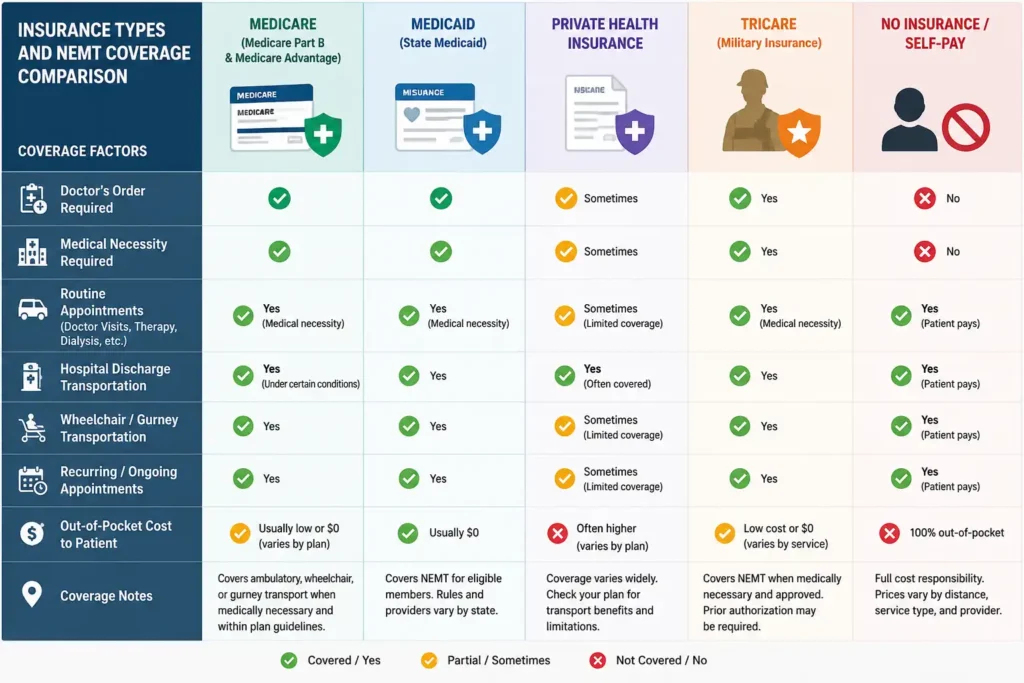
Comparison Table: Insurance Coverage for Non-Emergency Medical Transportation
| Insurance Type | General Coverage Level | Prior Authorization Needed | Common Qualifying Situations |
| Medi-Cal / Medicaid | Generally strong, often required by federal law | Yes, physician certification typically required | Dialysis, wheelchair transport, hospital discharge, therapy |
| Original Medicare | Limited, mostly ambulance-focused | Yes, medical necessity documentation | Emergency or specific non-emergency ambulance situations |
| Medicare Advantage | Often included as supplemental benefit | Varies by plan | Routine medical appointments, dialysis, specialist visits |
| Private Insurance | Highly variable | Usually yes | Cancer treatment, dialysis, specific chronic conditions |
| No Insurance / Self-Pay | Not applicable | Not applicable | Direct payment to transportation provider |
What If Your Insurance Doesn’t Cover Your Situation?
Not every patient fits neatly into one of these coverage categories, and that’s a genuinely common situation. Maybe your Medi-Cal application is still pending, your Medicare Advantage plan has already used up its annual trip allowance, or your private insurer denied your transportation request. In these cases, you still have options.
Self-Pay Options Remain Available
Many families choose to pay directly for non-emergency medical transportation when insurance coverage isn’t available or doesn’t fully apply. This is often more affordable than people expect, particularly compared to the cost and inconvenience of missing appointments or relying on family members to take unpaid time off work repeatedly.
Specific Situations Worth Understanding
Different medical situations often call for different types of transportation, and knowing which one applies to you helps when you’re arranging a ride outside of insurance coverage:
- Patients needing routine transport who can walk with some assistance typically use ambulatory transportation services
- Patients who use a wheelchair full-time need wheelchair transportation vehicles equipped with ramps or lifts
- Patients with more complex medical needs, including those who must remain lying down, require gurney transport
- Elderly patients managing multiple ongoing appointments often benefit from senior transportation services built around recurring scheduling
- Patients being released from the hospital who need direct support getting home safely should look into best transportation services for hospital discharge
- Anyone searching broadly for options in their area can start with medical transportation near me to see what’s locally available
How to Verify Your Coverage Before Booking a Ride
Rather than assuming coverage one way or the other, taking a few specific steps before your appointment can save considerable stress and unexpected costs.
Step 1: Call Your Insurance Provider Directly
Ask specifically about non-emergency medical transportation benefits rather than general transportation coverage, since insurers sometimes distinguish between these terms internally. Have your member ID ready and ask the representative to note the conversation in your file.
Step 2: Get Physician Documentation Early
If your insurance requires medical necessity certification, request this from your doctor as early as possible, ideally at the same appointment where the need for ongoing transportation becomes clear, rather than waiting until the day before your next scheduled ride.
Step 3: Ask About Recurring Appointment Coverage
If you’re managing something like dialysis or radiation therapy that requires multiple trips per week, ask specifically whether your coverage extends to recurring rides or requires separate authorization for each individual trip. This distinction matters enormously for patients managing long-term treatment schedules, including those needing transportation to radiation therapy multiple times per week.
Step 4: Confirm In-Network Requirements
Some insurance plans only cover transportation through specific approved providers. Confirm this before booking, since using an out-of-network provider could mean paying out of pocket even when your plan technically covers NEMT.
Special Situations Worth Knowing About
Hospital Discharge Transportation
Getting home safely after a hospital stay is one of the most common reasons people need non-emergency medical transportation, and it’s also one of the situations where insurance coverage tends to be more straightforward, since hospitals often help coordinate this directly as part of discharge planning.
Long-Distance Medical Transportation
Patients traveling to specialized treatment centers outside their immediate area face additional coverage complexity. Insurance coverage for long-distance medical transportation trips often requires additional documentation showing that the specific treatment isn’t available closer to home.
Same-Day and Urgent Scheduling Needs
Sometimes a medical situation arises that requires transportation on short notice, even though it isn’t a true emergency. Coverage for same-day NEMT requests can be more limited than scheduled appointment coverage, so it’s worth understanding your plan’s specific policy on urgent, non-emergency requests.
Transportation for Adults With Disabilities
Coverage considerations can differ for transportation for disabled adults , particularly around long-term or recurring transportation needs tied to ongoing disability-related care.
Airport Medical Transportation
For patients traveling to receive treatment from out of town, airport medical transportation services help bridge the gap between flights and appointments, though this is an area where insurance coverage is less standardized than local appointment transportation.
Frequently Asked Questions
Does Medi-Cal cover non-emergency medical transportation in California?
Yes, Medi-Cal generally covers non-emergency medical transportation when a physician certifies that it’s medically necessary, particularly for patients who cannot safely use standard transportation due to their medical condition.
Will Medicare pay for a wheelchair van to get to my doctor’s appointment?
Original Medicare typically does not cover standard wheelchair van transportation for routine appointments. However, if you have a Medicare Advantage plan, many include this as a supplemental benefit, so it’s worth checking your specific plan.
Does private health insurance cover transportation to dialysis?
This depends entirely on your specific plan. Some employer-sponsored plans include limited transportation benefits for dialysis and similar recurring treatments, while others don’t cover it at all. Contacting your insurer directly is the most reliable way to find out.
Do I need a doctor’s note to get non-emergency medical transportation covered?
In most cases, yes. Insurance providers, especially Medicaid and Medicare Advantage plans, typically require documentation from a physician confirming that transportation is medically necessary before authorizing coverage.
What happens if my insurance denies coverage for medical transportation?
If coverage is denied, you can typically appeal the decision with additional documentation from your doctor, or arrange transportation on a self-pay basis while the appeal is processed.
Is hospital discharge transportation usually covered by insurance?
This varies, but hospital discharge transportation is often one of the more straightforward situations for coverage, since hospitals frequently help coordinate this as part of the discharge planning process.
Can I get non-emergency medical transportation covered for multiple appointments per week?
Yes, in many cases, though you may need to request specific authorization for recurring transportation rather than a single trip, particularly for treatments like dialysis or radiation therapy that require frequent visits.
What should I do if I don’t have insurance at all?
Self-pay options remain available for non-emergency medical transportation, and many providers offer more affordable rates than people initially expect, especially compared to the cost of missed appointments.