A missed appointment rarely happens because someone forgot. It happens because the ride fell through. A daughter’s work schedule changed, a parent stopped driving after a fall, or the bus stop turned out to be too far to walk. Many families reach for their Medicare card at that point and wonder whether a ride is part of the deal, so does Medicare offer free transportation for seniors?
The short version is that Original Medicare usually does not, but there are important exceptions, and other programs can fill the gap. This guide explains what each type of coverage does and doesn’t pay for, how to check your own plan, and what free and low-cost options exist around Sacramento.

Does Medicare Cover Free Senior Transportation? The Short Answer
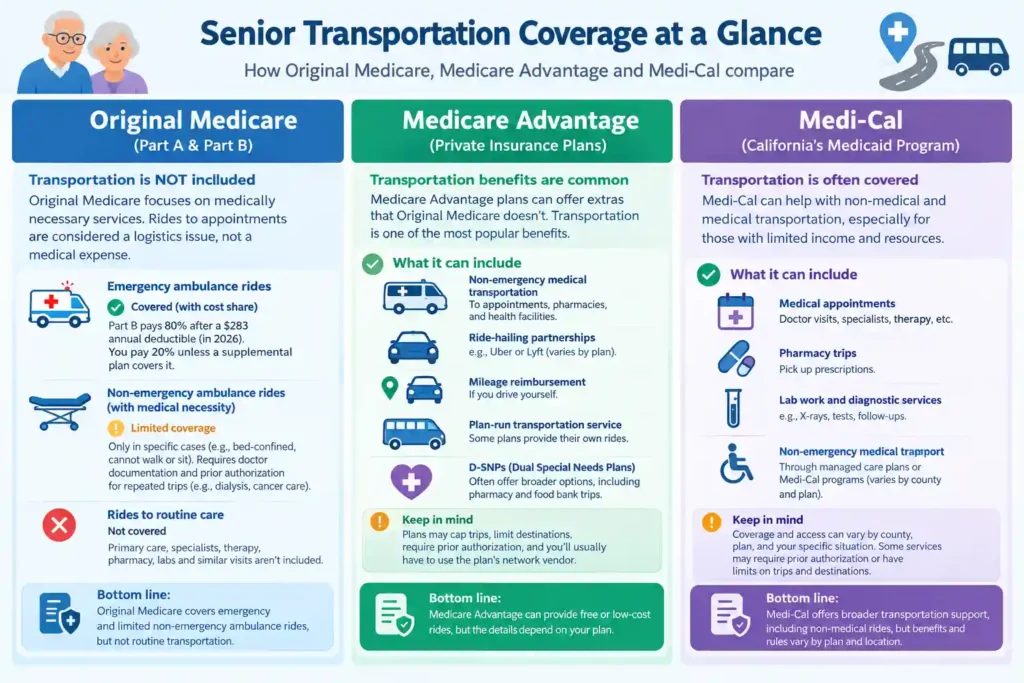
No, not as a general benefit. Rides to routine medical appointments generally aren’t covered under Original Medicare, and only some Medicare Advantage plans include them, although both cover emergency and certain non-emergency ambulance trips.
Here is how it breaks down:
- Original Medicare (Part A and Part B): usually no coverage for rides to regular appointments. Ambulance transport is covered in emergencies and in limited non-emergency situations.
- Medicare Advantage (Part C): may include a ride benefit, but it depends entirely on your specific plan.
- Medi-Cal: can cover non-emergency rides for eligible members, including many seniors who qualify for both programs.
- Community and public programs: paratransit, senior fare programs, and non-profit ride services can fill remaining gaps.
The word “free” deserves a second look, too. Even where a ride benefit exists, it often comes with trip limits, distance limits, advance-booking rules, or prior authorization.
What Original Medicare Covers, and What It Skips
Original Medicare focuses on medically necessary services and supplies. Transportation is generally treated as a logistics problem rather than a medical expense, which is why the ride to the clinic isn’t part of the package.
Emergency ambulance rides
Medicare does cover emergency ambulance transport. You still pay a share, though. In 2026, Part B pays 80% of covered emergency ambulance transport after you meet a $283 annual deductible. The remaining 20% is your responsibility unless a supplemental plan picks it up. Non-emergency ambulance rides with medical necessity
In limited cases, Medicare may pay for non-emergency ambulance transport. Medicare’s test for a person who is “bed-confined” requires that they cannot get up from bed without help, cannot walk, and cannot sit in a chair or wheelchair. Documentation from a doctor matters, and a prior authorization program for repeated non-emergency ambulance trips, such as recurring dialysis or cancer care, was expanded nationwide in 2020.
This is the exception that trips people up. A wheelchair van or other non-medical ride is far cheaper than an ambulance but does not meet Medicare’s ambulance criteria, so don’t assume a wheelchair ride to a routine visit will be covered. Our related blog post on gurney transport versus ambulance service explains how to tell which type of ride fits a given situation, and when Medicare’s ambulance rules apply.
Rides Original Medicare generally skips
Rides to primary care visits, specialist appointments, therapy sessions, pharmacy trips, and lab work are typically not covered under Original Medicare. If you need a ride for one of those, you’ll want to look at the next three sections.
Medicare Advantage: Where Free Rides Can Come From
Medicare Advantage plans are run by private insurers and can offer extras that Original Medicare does not. Transportation is one of the most common. According to KFF data cited by AARP, in 2024 about 36 percent of regular Medicare Advantage plans and 88 percent of special needs plans offered a transportation benefit for medical needs.
What that benefit looks like varies a lot. One example is a $0 copay for up to 36 one-way trips per year to approved health-related locations such as doctor visits. Depending on the plan, you may see:
- Non-emergency medical transportation to and from appointments, pharmacies, and health facilities
- Partnerships with ride-hailing companies
- Mileage reimbursement if you drive yourself
- A plan-run transportation service
Dual Special Needs Plans, often called D-SNPs, frequently offer broader options, including trips to pharmacies and food banks.
The fine print is where “free” gets complicated. Plans may cap trip frequency or distance, limit covered destinations, or require prior authorization, and the Summary of Benefits is where those limits are spelled out. If your plan includes a ride benefit, you’ll usually have to use the plan’s network vendor rather than any provider you choose.
Medi-Cal: Coverage for Seniors Who Qualify
Many older Californians have both Medicare and Medi-Cal. When a person qualifies for both, Medicaid may cover non-emergency medical transportation to doctor visits, and rules differ by state. In California, Medi-Cal splits transportation into two categories.
Non-emergency medical transportation (NEMT)
NEMT covers ambulance, litter van, and wheelchair van services when a member’s condition makes ordinary public or private transportation medically inappropriate and the ride is needed to get medical care. It requires paperwork. A signed Physician Certification Statement form is required for NEMT. In practical terms, a doctor, physician assistant, or certified nurse midwife certifies the level of transport you need.
The form matters because it decides the vehicle type. Plans authorize the lowest-cost type of medical transportation that is adequate for the member’s needs, and once a physician prescribes the mode, the plan cannot change it. Some plans have said that using a walker or cane alone is not enough to justify NEMT. Members who need a wheelchair to be safely transported are a different story. If that describes your loved one, see our wheelchair transportation in Sacramento page.
Non-medical transportation (NMT)
If a senior can safely ride in a private car, taxi, or bus, the ride falls under non-medical transportation instead. Medi-Cal managed care plans must provide NMT for all Medi-Cal services, including some that fall outside the plan’s own contract. Check with your plan for how to request it and how far in advance you need to call.
A ride that a walking rider needs, with a driver who understands how to help, is a common fit for what’s called ambulatory transportation. We explain who benefits in our related blog post on ambulatory transportation.
Side-by-side comparison
| Program | Routine Ride to Appointments? | Typical Catch |
| Original Medicare | Generally no | Ambulance only, with medical necessity rules |
| Medicare Advantage | Sometimes | Trip limits, network vendors, prior authorization |
| Medi-Cal (NEMT) | Yes, if eligible | Physician Certification Statement required |
| Medi-Cal (NMT) | Yes, if eligible | Plan-specific booking rules |
| Private pay | Yes | You cover the cost |
Does Medicare offer free transportation for seniors? What to Do If Your Plan Says No
If your plan doesn’t include rides, you still have options. Work through them in this order.
- Ask your doctor’s office. Staff often know which programs your clinic works with, and a doctor can complete the paperwork some programs require.
- Check Medi-Cal eligibility. Seniors on limited incomes may qualify, and some qualify for both programs.
- Look at public transit and senior fares. Other options include rideshare, taxi, public transportation, paratransit, or a ride arranged through a local non-profit.
- Contact your local Area Agency on Aging. These agencies support senior mobility programs, and Area 4 Agency on Aging funds a voucher program in nearby Yolo County that provides bus tickets to eligible seniors. Ask what exists for your zip code.
- Consider a private medical ride. When accessibility and hands-on help matter, a trained provider may be worth the cost.
Free and low cost rides around Sacramento
Two public options are worth knowing about.
SacRT GO is a paratransit service. SacRT GO provides door-to-door rides for people who cannot use SacRT bus or light rail because of a disability, serving Sacramento, Citrus Heights, Elk Grove, Folsom, and Rancho Cordova. Eligibility rules apply, and it is not free.
Elk Grove residents may also qualify for a free option. The city approved a one-year Seniors Ride Free pilot letting residents 62 and older ride certain SacRT buses at no charge, but it excludes light rail, GO Paratransit, and SacRT Flex, and riders need a pass and government ID. That helps seniors who can comfortably use a fixed-route bus. It doesn’t help someone who needs a ramp, a lift, or door-to-door help. If you’re in the south county, you can read about our medical transportation service in Elk Grove for rides that go door to door.
When a Private Medical Ride Makes Sense
Public and plan-based programs work well for many trips, but they have limits: fixed schedules, booking windows, no help at the door, or no coverage for the destination you need. Private non-emergency medical transportation fills those gaps.
It tends to fit best when:
- Your loved one uses a wheelchair or needs help getting from the front door to the vehicle
- The trip is time-sensitive, such as a discharge or a same-day appointment
- Appointments recur on a fixed schedule, such as dialysis or therapy
- The destination is outside the usual plan network or a long way from home
- Family can’t drive, and you need someone reliable each time
| Situation | Likely Best Path |
| Walks unaided, plan includes rides | Plan-provided ride benefit |
| Walks unaided, no ride benefit | Public transit, senior fares, or a private ambulatory ride |
| Uses a wheelchair full-time | Medi-Cal NEMT if eligible, or a private wheelchair ride |
| Cannot sit upright | Gurney transport with physician documentation |
| Needs a ride today | Same-day private medical transport |
| Long trip outside Sacramento | Long-distance medical transport, quoted in advance |
Costs vary by vehicle type and distance. If you’re curious what to expect, our related blog post on the cost of non-emergency medical transport in Sacramento lays out how pricing typically works.
How to Find Out What Your Plan Covers
So, does Medicare offer free transportation for seniors in your specific situation? Only your own plan can answer that, and it takes about fifteen minutes to find out.
- Find your plan type. Look at your card. Original Medicare shows a red, white, and blue card. A Medicare Advantage plan shows the insurer’s name.
- Open the Summary of Benefits. Search for “transportation” or “rides” and note trip limits, destinations, and any copay.
- Call the member services number on your card. Ask whether transportation is a benefit, how many trips you get, whether trips are one-way or round trip, and how far in advance you must book.
- Ask whether prior authorization is required, and who submits it.
- If you have Medi-Cal, ask your plan about NEMT and NMT and whether your doctor must complete a Physician Certification Statement.
- Write down the name of the person you spoke with and the date. Keep a copy of any approval.
If you get stuck, First Med Transit can help sort out the paperwork side. We help check eligibility and required documents for covered non-emergency medical transportation services.
Mistakes to Avoid
- Assuming Original Medicare covers rides. It usually doesn’t, apart from ambulance situations.
- Booking a ride before confirming coverage. Some plans require approval in advance, and an unapproved trip may not be reimbursed.
- Using a non-network vendor when your plan requires its own.
- Overlooking trip caps. A benefit of a set number of one-way trips can run out mid-year, especially with recurring treatment.
- Confusing emergency and non-emergency situations. Gurney transport and wheelchair transport are not substitutes for 911 in a true emergency.
- Skipping the doctor’s office. A missing form is the most common reason approvals stall.
How First Med Transit Helps Sacramento-Area Seniors
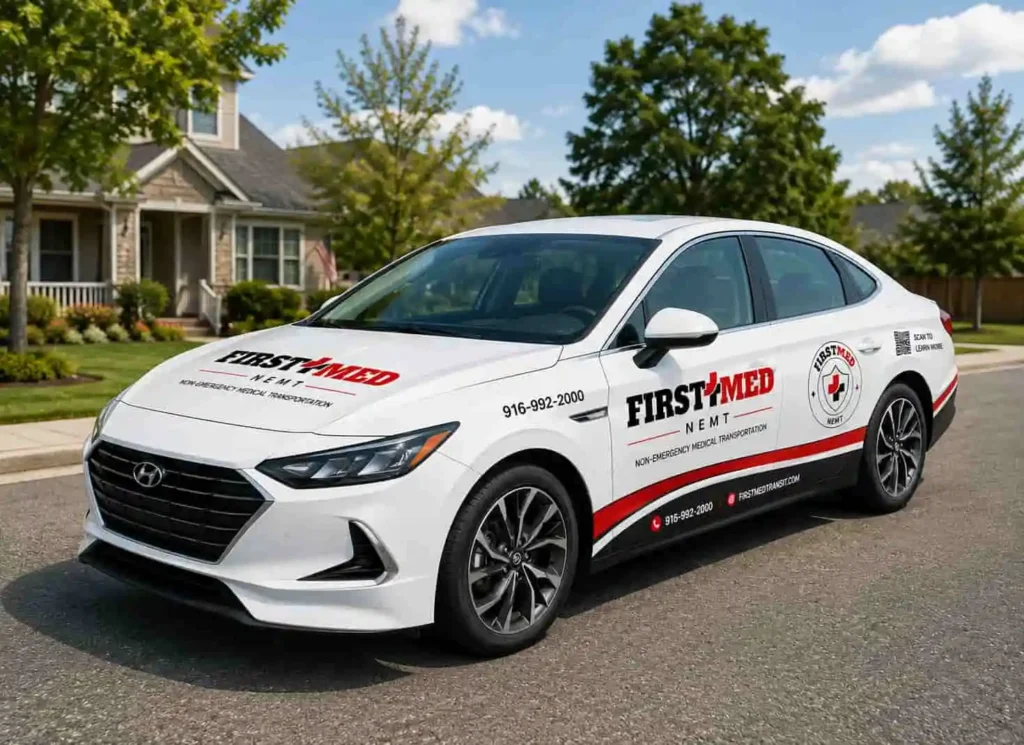
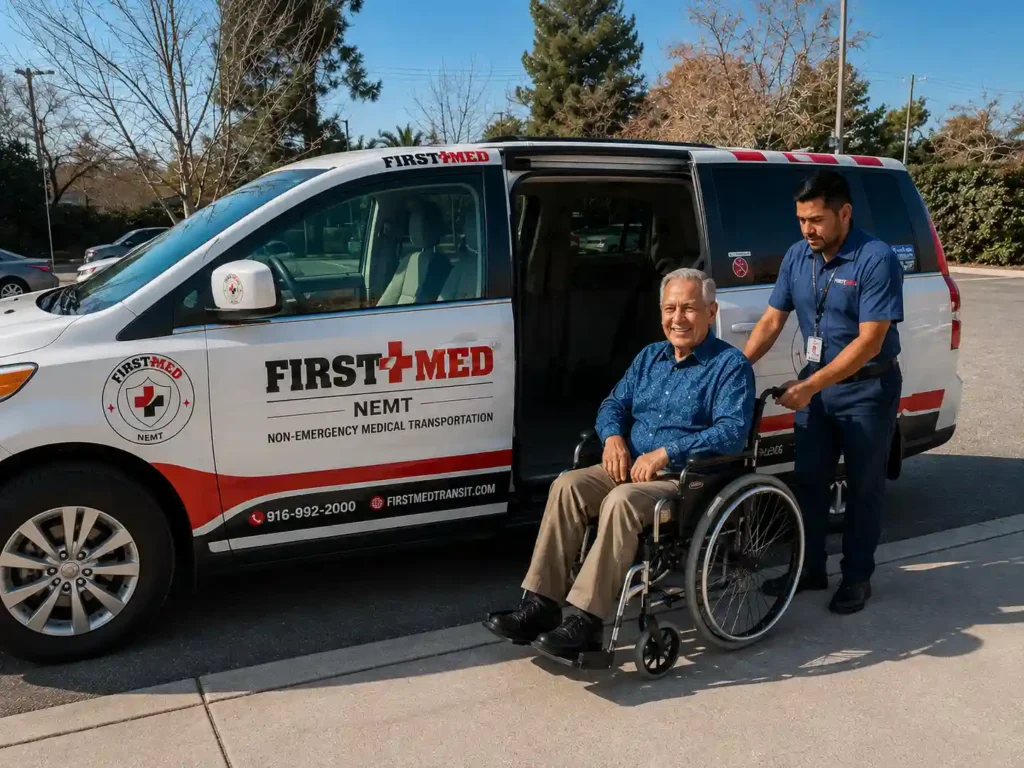
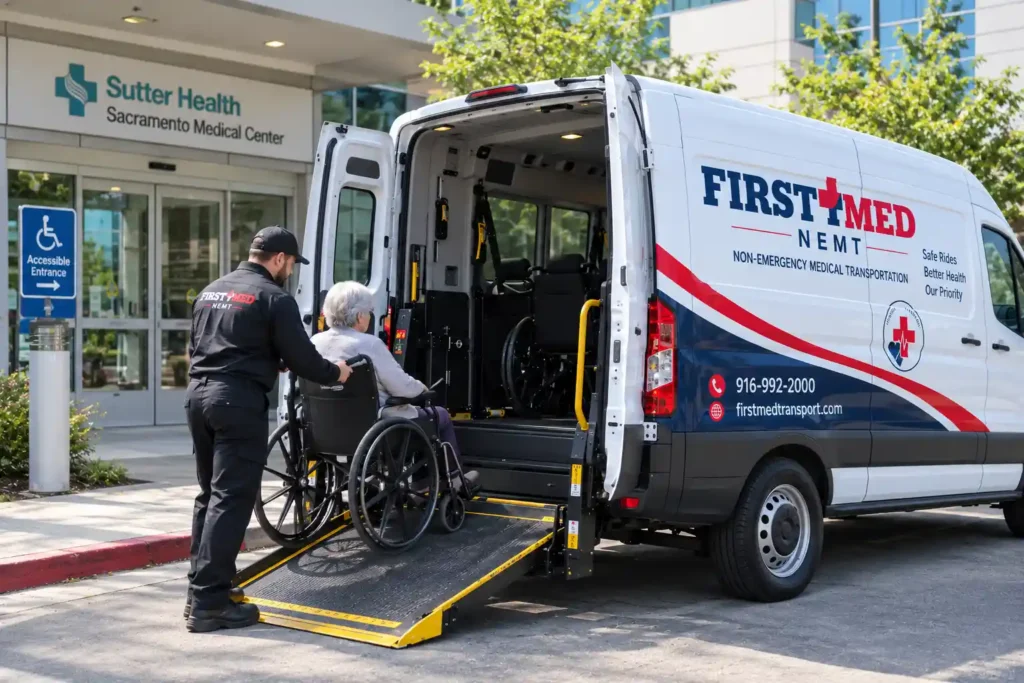
First Med Transit provides non-emergency medical transportation for wheelchair, gurney, and ambulatory riders across the greater Sacramento and Central Valley area. Our approach is built around seniors and families who need dependable rides, not just any vehicle. We accept Medi-Cal, many insurance plans, and private pay, with flexible advance scheduling and same-day service when available. Our drivers are CPR and first aid certified and trained to handle mobility equipment with care.
Our senior transportation in Sacramento service is built for recurring appointments such as therapy, lab work, and dialysis, as well as hospital-to-home trips.
If you need a ride on short notice, our same-day non-emergency medical transportation service can help when a vehicle is available.
For appointments farther afield, our long-distance medical transportation service covers out-of-area trips. We can accommodate long-distance trips from Sacramento up to 500 miles.
We also serve nearby communities, including Roseville, so if you’re in Placer County, take a look at our page on non-emergency medical transportation in Roseville.
For a full overview of our services, visit our non-emergency medical transportation Sacramento page.
Frequently Asked Questions About Medicare and Senior Transportation
Does Original Medicare pay for rides to the doctor?
Generally no. Original Medicare doesn’t cover routine non-emergency rides to appointments. It covers emergency ambulance transport, and it may cover some non-emergency ambulance trips when medical necessity is documented.
Do Medicare Advantage plans include free rides?
Some do. Benefits vary by plan and by year, and many include trip limits, network vendors, or prior authorization. Your plan’s Summary of Benefits will show exactly what is offered.
Can a senior get rides through both Medicare and Medi-Cal?
Yes. Members who qualify for both may be able to use Medi-Cal for rides Medicare doesn’t cover. Ask your plan whether NEMT or NMT applies and whether your doctor needs to complete a form.
What is the difference between NEMT and NMT in Medi-Cal?
NEMT covers ambulance, litter van, and wheelchair van rides for members whose condition prevents them from safely using ordinary transportation. NMT covers rides for members who can travel by private car, taxi, or bus. NEMT requires physician certification.
Will Medicare pay for a wheelchair van?
Typically not under Original Medicare, because a wheelchair van doesn’t meet the ambulance criteria. Medi-Cal or a Medicare Advantage plan may cover it, depending on eligibility and plan rules.
Are there free rides for seniors in Sacramento?
There are free and low-cost options. Elk Grove’s Seniors Ride Free pilot covers certain SacRT bus routes for residents 62 and older, and SacRT GO offers door-to-door paratransit for those who qualify. Neither is a substitute for help at the door if you need it.
How do I book a private medical ride?
Call our team or use the online request form with your pickup address, destination, appointment time, and the type of assistance needed. You’ll receive a confirmation with the details once your ride is scheduled.
Is a ride from a medical transport company the same as an ambulance?
No. Non-emergency medical transport is for scheduled trips for people who are medically stable. Ambulances are for emergencies, and gurney vehicles and staff aren’t equipped to handle them.