Picture a busy hospital hallway. A nurse calls for a gurney, two paramedics push one through the double doors, and a visitor from London quietly wonders why nobody said “trolley.” That small moment of crossed wires sits behind a surprising number of searches, and it matters more than it seems when you’re arranging a medical ride for someone you love. The label on a form can decide which vehicle shows up.
This guide gives you the quick answer first, then fills in the rest: where the word comes from, how a gurney differs from a stretcher, what hospital staff and EMS crews actually call it, and how the vocabulary shows up on paperwork for non-emergency medical transportation in Sacramento, CA. If someone you know needs a lying-down ride soon, the booking section near the end lists exactly what to have ready.

Quick Answer: What do Americans call a gurney?
Americans call a wheeled stretcher a gurney: a padded, height-adjustable bed on wheels that moves someone who needs to lie down. You’ll hear the word in hospitals, on ambulances, in the news and in everyday conversation. Depending on who is talking, the same device may also be called a stretcher, a cot or, informally, a cart.
The question “what do Americans call a gurney?” usually comes from one of three people. The first is a traveler or newcomer from the UK, Australia or another country where the word is trolley. The second is a writer or translator who wants dialogue to sound right for American readers. The third, and the reader this article cares about most, is a family member who has just heard the phrase “gurney transport” after a hospital stay and has no idea what it means in practice.
Here is the vocabulary at a glance:
- Gurney: the everyday American word for a wheeled stretcher.
- Stretcher: the broader umbrella term. Every gurney is a stretcher, but plenty of stretchers have no wheels.
- Cot or ambulance cot: the name many EMS crews use for the wheeled stretcher that loads into an ambulance.
- Cart: an informal label you may hear from hospital staff.
- Trolley: the British and Commonwealth equivalent.
Learn About: Which is cheaper, Uber or airport taxi?
What a Gurney Actually Is
A gurney is a stretcher built on a wheeled frame. Because it rolls, one trained person can move it along a corridor, while a basic carry stretcher has to be lifted by two or more people. The head section on most models tilts up or lowers flat, which helps when someone needs to sit partly upright for comfort or lie completely level for a transfer.
Modern gurneys share a handful of features:
- A padded surface long enough for an adult to lie on comfortably
- Wheels with locking brakes
- A frame that raises and lowers to match a bed, exam table or vehicle floor
- Head and leg sections that adjust independently
- Side rails and restraint straps
- Mounting points for IV poles and similar equipment
- On ambulance models, a lug that locks into a latch in the vehicle so the cot can’t shift while moving
Gurneys turn up in more places than most people expect: emergency departments, imaging rooms, surgery prep areas, hospital hallways, ambulances and non-emergency transport vans. Seeing someone on a gurney doesn’t automatically signal an emergency. More often it means the person needs to lie flat while being moved safely from one place to another.
Where the Word Gurney Comes From
Nobody has pinned down the origin for certain. The explanation you’ll see most often credits J. Theodore Gurney, an American inventor who patented a horse-drawn cab in 1883 that resembled early wheeled stretchers. Dictionaries still list the origin as uncertain, and some accounts point to Pacific Coast slang instead.
The timeline is easier to trust than the backstory. The word was in hospital use by the 1930s, and dictionaries first record it between 1935 and 1940. One dictionary note adds that it first named hospital carts used for food and laundry, before it settled on the kind that carries people. That fuzzy past is a big reason its neighbors (stretcher, cot, litter and trolley) get swapped so freely.
Gurney vs Stretcher: What Actually Separates Them
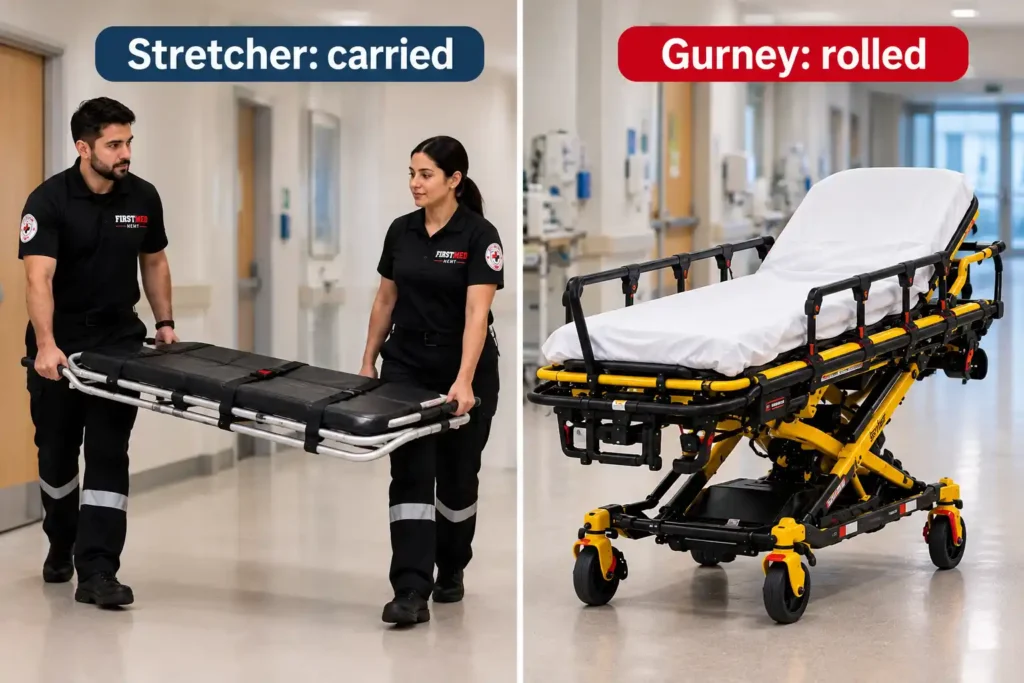
In casual speech the two words overlap, and nobody will correct you for mixing them up. In technical terms, stretcher is the family and gurney is one member of it. A gurney is essentially a stretcher on wheels with an adjustable frame, which is why a single trained person can handle it, while a plain stretcher needs several hands.
| Feature | Basic stretcher or litter | Gurney (wheeled stretcher) |
| Wheels | None | Yes, usually with locking brakes |
| How it moves | Carried by hand | Rolled |
| People needed to move it | Two or more | One trained person can roll it |
| Height adjustment | Usually fixed | Typically adjustable |
| Typical settings | Rescue work, military use, tight spaces, backup equipment | Hospitals, ambulances, medical transport vans |
| Best for | Reaching places wheels can’t go | Moving someone smoothly between rooms, vehicles and facilities |
Basic stretchers still earn their place. A scoop stretcher, for example, splits into two halves so crews can lift someone from the ground without rolling them, and a folding model slips through spaces a wheeled frame can’t. For scheduled trips between a bed, a vehicle and a care facility, though, the gurney is the standard tool because it keeps the person level, supported and moving smoothly the whole way.
Cot, Cart, Litter, Trolley: The Other Words You Will Hear
Vocabulary shifts with the setting as much as with the country. Here is how the labels usually sort out:
| Word | Where you hear it | What it usually means |
| Gurney | Everyday American English, hospitals, news, TV | A wheeled stretcher |
| Stretcher | Everywhere, formal and informal | The umbrella term, wheeled or carried |
| Cot or ambulance cot | US EMS crews | The wheeled stretcher that locks into an ambulance |
| Cart | Informal, some US hospitals | A wheeled stretcher or transport cart |
| Litter | Military and rescue settings, plus transport paperwork | A basic carried stretcher; a “litter van” is the vehicle that carries one |
| Trolley | UK and many Commonwealth countries | A wheeled hospital stretcher |
Why do Americans rarely say trolley? Mostly because the word already has jobs. To many Americans a trolley is a streetcar, and the thing you push around a supermarket is a cart, which leaves gurney free to name the hospital version. Some EMS professionals also keep “cot” for the ambulance model and “gurney” for the hospital one, though most people treat the two as interchangeable.
What do Americans call a gurney? How to Read Medical Transport Paperwork
Once you step into the world of scheduled medical rides, vocabulary gets practical. Transport companies, hospital discharge planners and health plans each use their own shorthand, and one vehicle can show up under three different names on three different documents. These are the terms you’re most likely to meet:
- Gurney van, litter van or stretcher van: a vehicle fitted to carry a person lying down
- Gurney transport, stretcher transport or supine transport: the service name for that kind of trip
- Bed-to-bed or door-to-door: the crew assists the rider from the starting bed or surface all the way to the destination
- Wheelchair van and ambulatory transport: seated options for riders who can sit upright
California’s Medi-Cal program shows why the naming matters. The state’s Department of Health Care Services requires a Physician Certification Statement, known as a PCS, to set the level of non-emergency medical transportation a person qualifies for. The PCS forms that Medi-Cal health plans publish list a gurney or litter van as a vehicle choice right beside wheelchair van. A provider signs the form, and in many plans the certification stays valid for up to a year. For a walk-through of verification and authorization in Sacramento County, see our page on Medi-Cal transportation.
When Gurney Transport Is the Right Ride
Gurney transport is a scheduled, non-emergency service for people who must stay lying down during a trip but aren’t in the middle of a medical emergency. It sits between a wheelchair van and an ambulance, and choosing the right level is the whole point. A doctor, discharge team or health plan usually decides which level fits, so treat this table as a map, not a prescription.
| Ride type | How the person travels | Typical trips | Emergency? |
| Ambulatory transport | Walks and sits upright, with or without a steadying arm | Clinic visits, therapy, follow-ups | No |
| Wheelchair transport | Stays seated in a wheelchair secured in the vehicle | Dialysis, specialist visits, regular appointments | No |
| Gurney transport | Lies down on a gurney or stretcher for the whole trip | Hospital discharge, facility transfers, appointments when sitting isn’t possible | No |
| Ambulance (call 911) | Receives medical care and monitoring during transport | Sudden or life-threatening situations | Yes |
Seated Options Come First
If the rider can sit upright safely, a seated service is usually the better match. Wheelchair transport secures the rider in their own wheelchair for the whole trip, and ambulatory transport suits people who can walk but want a steady arm and door-to-door help.
Hospital Discharge and the Ride Home
Discharge day is where gurney transport shows up most often. When someone is cleared to leave the hospital but can’t sit upright in a regular car, hospital discharge transport coordinates with the care team so timing and handoffs run smoothly, and the hospital to home trip happens bed to bed, with no car transfer to attempt.
Facility Transfers and Recurring Appointments
Nursing home and rehab residents who can’t use a seated vehicle rely on gurney transport to reach outside appointments. The same goes for dialysis transport when sitting upright isn’t an option: the ride is scheduled around treatment times so pickups and returns stay predictable.
When to Call 911 Instead
Gurney transport is for planned trips. Any sudden or life-threatening situation calls for 911, not a scheduled ride. If you’re weighing the two for a planned trip, our related blog post, gurney transport vs ambulance, lays out the differences and helps you decide which one you need.
What Happens During a Gurney Transport Trip
At First Med Transit, a gurney trip follows a predictable sequence, so families know what to expect:
- Request. Call or use the online form with the pickup address, destination, appointment time and the rider’s mobility needs.
- Planning. The team picks the right gurney equipment and vehicle setup, confirms the pickup time against the appointment and coordinates with the facilities at both ends.
- Pickup and transfer. Trained staff move the rider from the bed, chair or other surface onto the gurney, position them comfortably and secure them with restraints. Nobody rushes this step.
- The ride. The gurney is secured in the vehicle and the trip follows an efficient route to the destination.
- Arrival and handoff. Staff unload the gurney, move the rider to the right surface at the facility or home and speak with the receiving team.
- Return trip. If a ride back is needed, the pickup time is arranged at booking so nobody is left waiting.
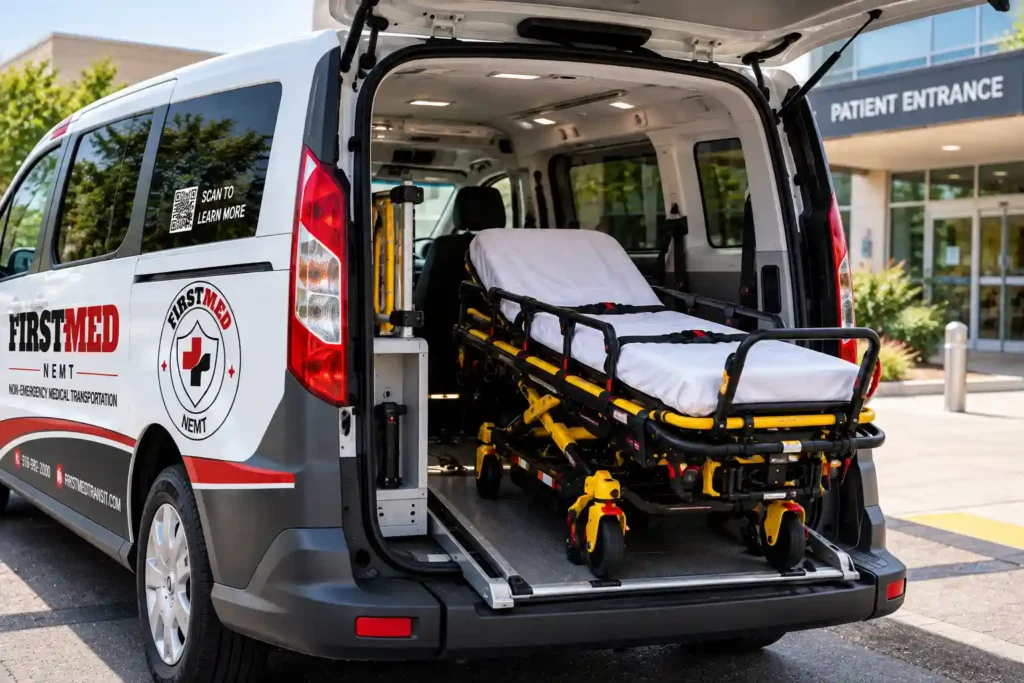
Our gurney-equipped vehicles are purpose-built for lying-down transport. Gurneys are inspected regularly, and each vehicle is cleaned and sanitized after every trip.
What a Careful Transfer Looks Like
Good gurney handling follows a few habits you can watch for as a family member. Wheels get locked during transfers, brakes stay on whenever the gurney stops (especially on slopes or ramps), and straps or rails hold the rider securely before anything moves. Crews also check the wheels, brakes and adjustable parts before each use, and they move slowly and smoothly so the rider isn’t jostled. If something looks rushed or unsecured, say so. A good crew welcomes the question.
How to Book Gurney Transport in Sacramento
If you need gurney transport in Sacramento, booking takes one phone call or one online form. Having the details below ready speeds things up and helps the team send the right equipment the first time.
What to have ready:
- Pickup address, including floor level, stairs, elevator or ramp access
- Destination address and the appointment or discharge time
- Whether the rider must lie completely flat for the whole trip
- Any equipment traveling along, such as oxygen or an IV pole
- Weight or size considerations, so the team can confirm the right gurney (some plan forms ask whether a bariatric litter is required)
- Handling instructions from the hospital or facility
- Insurance or Medi-Cal details, if coverage is involved
- Return trip details, if you need one
Timing
For planned appointments, booking 48 to 72 hours ahead gives you the most scheduling options. Plans change, though, and discharge dates move. If you need a ride sooner, ask about same-day NEMT service. Availability depends on the day, so call as early as you can.
What Affects the Price
Pricing comes down to a handful of practical factors, not the word you use for the vehicle:
| Factor | Why it affects the price | How you can help |
| Trip distance | Longer trips use more vehicle and crew time | Share exact pickup and destination addresses |
| Level of assistance | Stairs, tight hallways and extra equipment add handling | Describe access and equipment when you book |
| Vehicle type | Gurney vehicles are equipped differently than wheelchair vans | Confirm the mobility need with the care team |
| Coverage | Medi-Cal, some insurance plans or private pay change what you owe | Have plan details and any authorization ready |
Which Word Should You Use? A Quick Guide
- Talking with US hospital staff: gurney and stretcher both work, and everyone will understand either.
- Writing for American readers: use gurney in dialogue and narration. Trolley reads as British.
- Writing for British readers: trolley is the natural choice.
- Calling a transport company: say “gurney transport” or “stretcher transport,” then describe what the rider needs in plain terms. The description matters more than the label.
- Reading insurance or health plan forms: look for “gurney van” or “litter van.”
- Hearing “cot” from an EMS crew: that’s the same device.
So the next time a friend asks “what do Americans call a gurney?”, you can answer in one breath: a gurney, though stretcher and cot will do just as well.
Frequently Asked Questions
What is a gurney called in the United States?
In the United States it’s called a gurney: a wheeled stretcher with an adjustable frame that moves someone who needs to lie down. Hospital staff may also say stretcher or cart, and EMS crews often say cot.
Is a gurney the same as a stretcher?
Nearly. A gurney is a stretcher with wheels and an adjustable frame. A basic stretcher has no wheels and is carried by two or more people, so every gurney is a stretcher, but not every stretcher is a gurney.
What is the British word for a gurney?
Trolley. British hospitals, and many in other Commonwealth countries, say trolley for the wheeled stretcher Americans call a gurney.
Why is it called a gurney?
The origin is uncertain. The most common explanation points to J. Theodore Gurney, an American inventor who patented a horse-drawn cab in 1883, while some accounts cite Pacific Coast slang. The word was in hospital use by the 1930s.
What is a gurney van or litter van?
It’s a non-emergency medical transport vehicle fitted to carry a person lying down on a secured gurney. Medi-Cal health plan forms use the labels gurney van and litter van, listing them next to wheelchair van options.
Is gurney transport the same as an ambulance?
No. An ambulance responds to emergencies and provides medical care in transit. Gurney transport is a scheduled, non-emergency ride for someone who must lie down but isn’t in an emergency. For any emergency, call 911.
Does Medi-Cal cover gurney transport?
It can. Medi-Cal may cover gurney or litter van transport for medically necessary trips, usually backed by a Physician Certification Statement signed by the rider’s provider. Rules differ by health plan, so confirm with your plan or ask First Med Transit to help verify coverage.