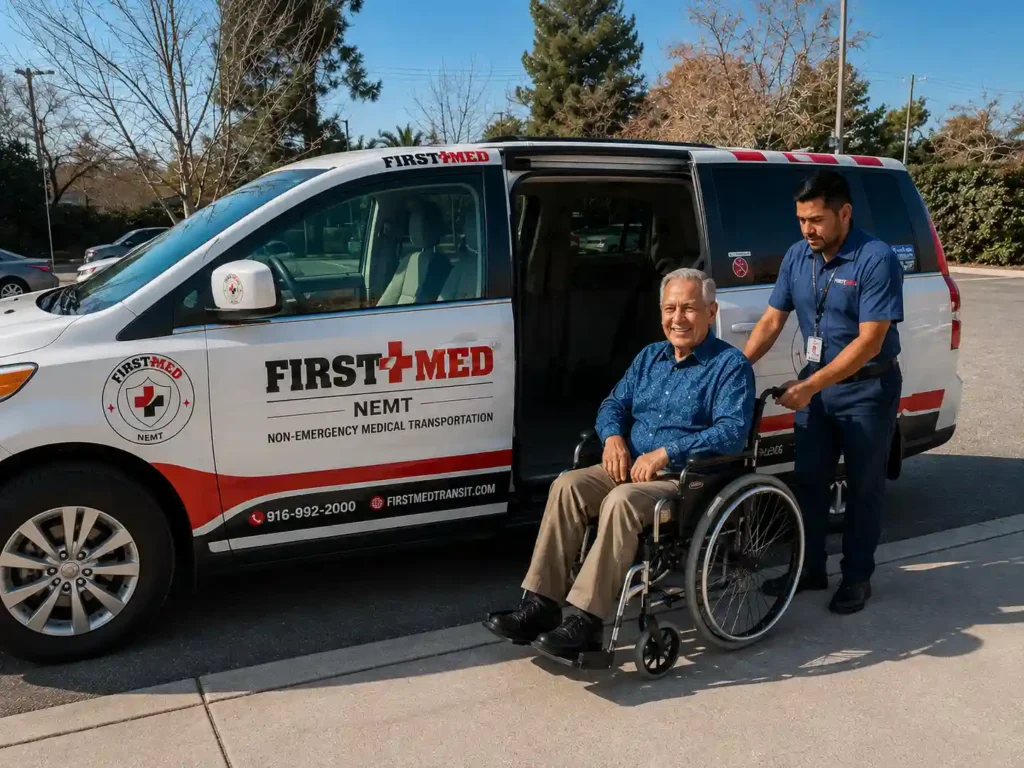
Getting into a regular taxi can be difficult when you use a wheelchair, especially if transferring to a standard car seat is uncomfortable or impractical. Wheelchair-accessible taxis provide an alternative by using specially equipped vehicles that accommodate mobility devices and support safer boarding.
How does a wheelchair taxi work? A wheelchair taxi uses a ramp or mechanical lift to help a wheelchair user enter the vehicle. Once positioned inside, the wheelchair is secured using a dedicated restraint system, and the rider uses an appropriate seat belt. A trained driver assists with boarding, transportation, and exiting at the destination.
These vehicles help wheelchair users travel to medical appointments, rehabilitation centers, hospitals, family gatherings, and other destinations without necessarily transferring out of their mobility devices.
Understanding the booking process, safety equipment, vehicle requirements, and transportation options can make arranging an accessible ride much easier.
What Is a Wheelchair Taxi?
A wheelchair taxi is a specially adapted vehicle designed to transport individuals who use wheelchairs or require additional mobility assistance.
Unlike a conventional taxi, a wheelchair-accessible vehicle has dedicated entry equipment and sufficient interior space to accommodate a wheelchair.
Depending on the vehicle, accessibility equipment may include:
- A manual or powered wheelchair ramp.
- A hydraulic or electric wheelchair lift.
- A lowered vehicle floor or modified entrance.
- A designated wheelchair seating area.
- A four-point wheelchair tie-down system.
- A separate lap-and-shoulder seat belt.
- Additional grab handles and mobility support features.
Some accessible taxis are modified minivans, while others are larger wheelchair-accessible transport vans.
Wheelchair taxi services can support both personal transportation and scheduled healthcare-related trips. However, not every accessible taxi provides the same level of assistance, so confirming the vehicle and service details before booking is important.
In Sacramento, individuals who require planned healthcare transportation can also use specialized wheelchair transportation services in Sacramento that accommodate mobility requirements and coordinate rides to medical facilities.
How does a wheelchair taxi work? Step-by-Step From Booking to Arrival
A wheelchair taxi operates through a coordinated process involving transportation scheduling, vehicle selection, assisted boarding, wheelchair securement, and safe arrival.
Although procedures vary between providers, most accessible transportation trips follow six main steps.
Step 1: Booking the Wheelchair-Accessible Taxi
The first step is contacting a transportation provider and requesting a vehicle designed for wheelchair accessibility.
When scheduling, provide the following information:
- Your complete pickup address.
- Your destination and preferred arrival time.
- The date and time of transportation.
- Whether you use a manual or powered wheelchair.
- Whether you intend to remain seated in your wheelchair.
- Any additional boarding or mobility assistance required.
- Whether you need one-way or round-trip transportation.
The transportation company uses this information to determine which vehicle can accommodate the rider and mobility equipment.
For example, a large powered wheelchair may require different doorway clearance, interior space, or lift capacity than a lightweight manual wheelchair.
Providing accurate information helps prevent equipment compatibility problems on the day of transportation.
Step 2: The Accessible Vehicle Arrives
At the scheduled pickup time, the driver arrives in a wheelchair-accessible taxi or transport van.
The driver should select a suitable stopping location with enough room to operate the ramp or lift safely.
This may involve positioning the vehicle near an accessible curb, driveway, or designated loading area.
Before boarding begins, the driver checks the surrounding area for obstacles, uneven surfaces, traffic, and other potential hazards.
For riders receiving door-to-door assistance, the driver may also help them travel from the building entrance to the vehicle.
Step 3: Boarding Using a Ramp or Lift
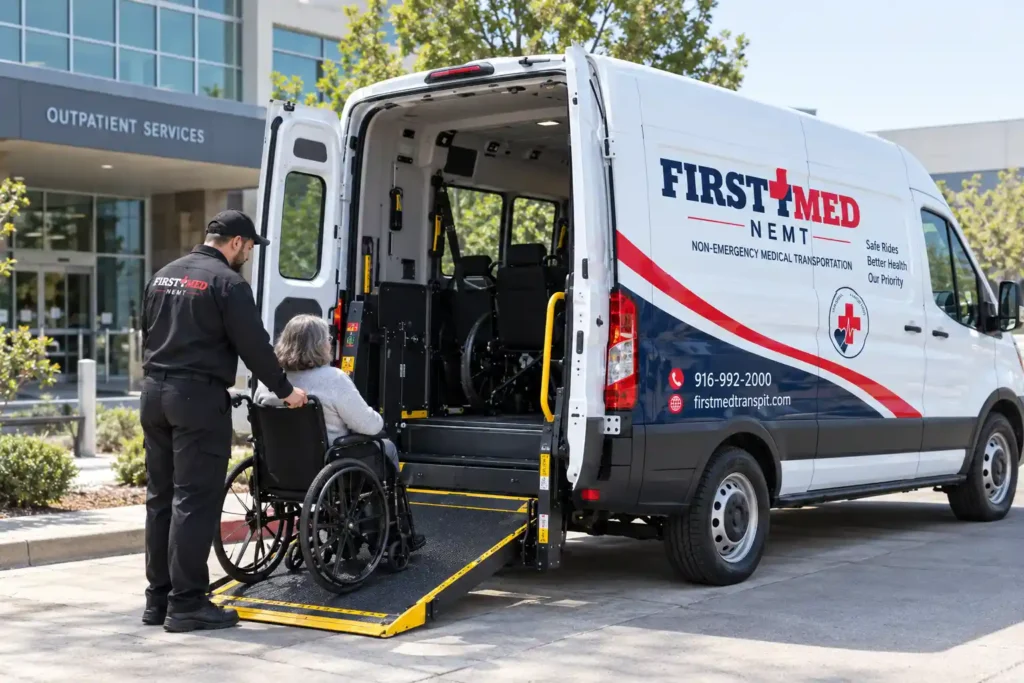
After the entrance is prepared, the rider boards through the vehicle’s accessibility system.
Two common boarding methods are used.
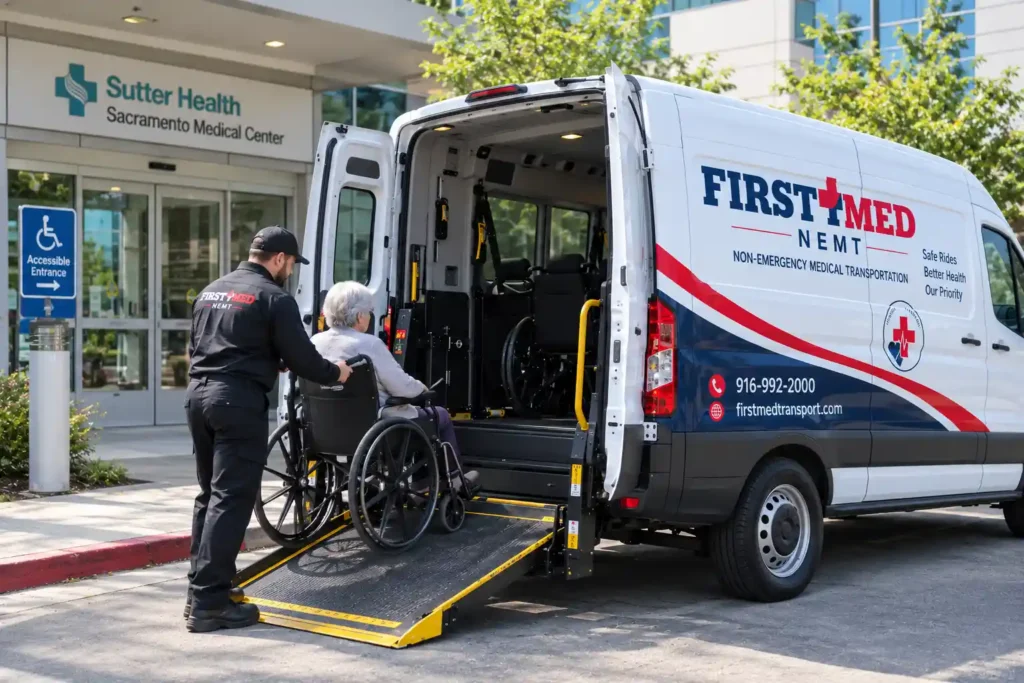
Wheelchair ramp: A ramp extends from the vehicle to the ground, allowing a manual or powered wheelchair to enter through an inclined surface.
Wheelchair lift: A mechanical platform raises the wheelchair from ground level to the vehicle entrance.
The driver operates or assists with the boarding equipment according to the vehicle’s procedures and the rider’s needs.
Wheelchairs should be moved slowly and carefully during boarding. Riders using power wheelchairs may need to follow specific manufacturer instructions when using lifts or ramps.
Before the vehicle moves, the driver ensures the accessibility equipment has been properly stowed.
Step 4: Securing the Wheelchair Inside the Vehicle
Once the rider reaches the designated wheelchair position, the driver secures the mobility device.
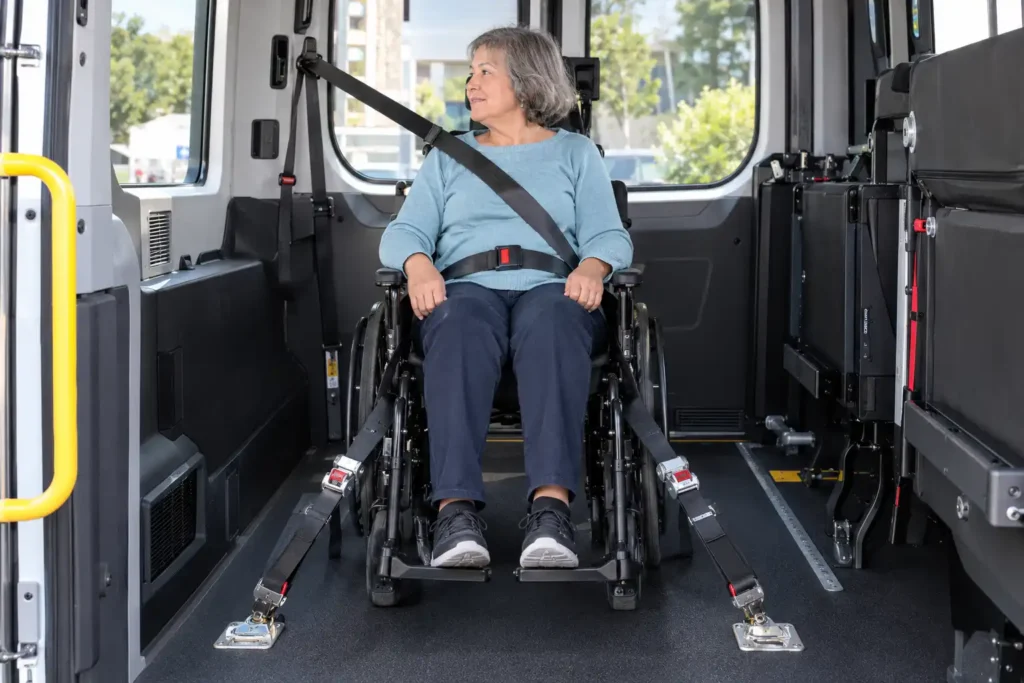
Many wheelchair-accessible vans use a four-point tie-down system.
This commonly involves securing the wheelchair at four appropriate locations using straps attached to the vehicle floor.
The restraint system helps limit unwanted wheelchair movement during acceleration, braking, and turning.
The rider also needs an appropriate occupant restraint, typically a lap-and-shoulder belt.
Securing the wheelchair and securing the person are separate safety requirements.
The driver should verify that the wheelchair is positioned correctly and that both restraint systems are properly fitted before departure.
Step 5: Traveling to the Destination
After completing the boarding and safety checks, the driver begins the journey.
During transportation, the driver follows normal traffic rules and operates the vehicle with attention to passenger comfort.
A smooth journey is especially important for wheelchair users who may experience discomfort from sudden braking, sharp turns, or rough road conditions.
Depending on the service, a family member or caregiver may be able to accompany the rider.
For scheduled healthcare transportation, the route and pickup time are generally planned around the appointment and expected travel duration.
Step 6: Safe Arrival and Wheelchair Unloading
When the vehicle reaches its destination, the driver parks in a suitable location and prepares the exit equipment.
The unloading process generally follows the boarding procedure in reverse.
The driver:
- Parks the vehicle and checks the unloading area.
- Releases the occupant restraint and wheelchair securement equipment.
- Deploys the ramp or lift.
- Assists the wheelchair user with exiting.
- Confirms that the rider has reached the agreed drop-off location safely.
Some services provide assistance to the entrance of a building, while others offer curb-to-curb transportation.
The exact level of assistance should be confirmed when booking.
How does a wheelchair taxi work? Understanding the Equipment Inside the Vehicle
A wheelchair taxi is more than a vehicle with extra interior space. Its accessibility and restraint systems work together to support safe transportation.
Wheelchair Ramps
A wheelchair ramp provides an inclined entry path between the ground and the vehicle floor.
Depending on the vehicle, ramps may be manually operated or powered.
Important features include adequate width, a suitable slope, a stable surface, and sufficient clearance.
Rear-entry wheelchair vans commonly use a ramp extending from the back of the vehicle, while side-entry vehicles allow boarding through a modified side door.
Hydraulic and Electric Lifts
Wheelchair lifts use a powered platform to raise or lower a wheelchair.
They may be particularly useful when the vehicle floor is too high for convenient ramp access.
The lift must be compatible with the combined weight and dimensions of the wheelchair and rider.
Proper positioning, platform barriers, and controlled operation are important during loading and unloading.
Four-Point Wheelchair Tie-Down Systems
A common wheelchair securement arrangement uses four attachments: two near the front and two near the rear of the wheelchair.
The attachments connect suitable wheelchair securement points to vehicle floor anchors.
The system is designed to restrain the wheelchair during transportation.
Tie-down straps should not be attached to detachable footrests, removable armrests, or other components that are not approved for securement.
Lap-and-Shoulder Seat Belts
A wheelchair restraint system holds the mobility device in position. It does not replace the rider’s personal seat belt.
An appropriate lap-and-shoulder belt helps protect the rider during sudden vehicle movements.
The lap belt should sit low across the pelvis, while the shoulder belt should follow the manufacturer’s positioning instructions.
Wheelchair positioning belts intended for everyday posture support are not necessarily substitutes for vehicle occupant restraints.
Different accessible vehicles use different layouts and boarding equipment. First Med Transit’s wheelchair-accessible vehicle fleet includes ramp-equipped and lift-equipped vans designed for a range of mobility transportation requirements.
Can You Stay in Your Wheelchair During a Taxi Ride?
Yes. Many wheelchair-accessible taxis allow riders to remain seated in their wheelchairs throughout the journey, provided the wheelchair, securement arrangement, and vehicle are suitable for that type of transportation.
This can eliminate an unnecessary transfer between the wheelchair and a vehicle seat.
However, not every mobility device is designed to function as a seat in a moving vehicle.
Wheelchairs intended for occupied vehicle travel may carry transportation safety information from their manufacturers. In the United States, ANSI/RESNA WC19 is an important voluntary standard for wheelchairs designed for use as seats in motor vehicles.
When a safe transfer is possible, using a conventional vehicle seat and seat belt is generally considered the preferred option for crash protection.
A wheelchair user should not assume that remaining seated is appropriate simply because the mobility device physically fits inside the vehicle.
Before booking, confirm:
- Whether the wheelchair is suitable for occupied vehicle travel.
- Whether the vehicle has compatible securement equipment.
- Whether the wheelchair’s dimensions fit the entrance and interior.
- Whether the rider can use an appropriate occupant restraint.
- Whether a transfer is preferred or necessary for the planned arrangement.
Accessibility requirements and transfer rights also depend on the transportation service and applicable regulations.
What Types of Wheelchairs Can Use Accessible Taxi Services?
Wheelchair-accessible transportation can accommodate various mobility devices, depending on vehicle capacity and equipment compatibility.
| Wheelchair or mobility device | Transportation considerations |
| Manual wheelchair | Often compatible with accessible vans when dimensions and securement points are suitable |
| Power wheelchair | Requires confirmation of weight capacity, dimensions, and securement compatibility |
| Lightweight transport wheelchair | May be transported occupied when suitable, or folded and secured if the rider transfers |
| Bariatric wheelchair | Requires confirmation of combined weight, doorway clearance, and interior space |
| Customized wheelchair | May require additional checks for mounted equipment and securement access |
| Mobility scooter | Generally not intended for occupied vehicle travel; a transfer to an approved seat may be necessary |
Special seating supports, trays, bags, or mounted equipment should be discussed with the transportation provider.
The driver should follow the vehicle restraint manufacturer’s instructions and the wheelchair manufacturer’s transportation guidance.
A key practical lesson is that wheelchair accessibility and wheelchair compatibility are not identical.
Wheelchair Taxi vs. Regular Taxi vs. Medical Transportation
Understanding the different transportation options makes it easier to choose the appropriate service.
| Feature | Regular Taxi | Wheelchair-Accessible Taxi | Wheelchair NEMT |
| Wheelchair ramp or lift | Usually unavailable | Typically included | Included in appropriately equipped vehicles |
| Remain seated in a wheelchair | Usually not possible | Often possible when compatible | Often possible when compatible |
| Wheelchair securement equipment | Generally unavailable | Available in equipped vehicles | Available in wheelchair transport vehicles |
| Scheduled medical appointments | Possible | Possible | Core service |
| Mobility assistance | Varies | Varies by operator | Planned around transportation needs |
| Return-trip coordination | Depends on booking | Depends on provider | Commonly available |
| Insurance-based transportation | Generally limited | Depends on program | May qualify under applicable benefits |
A regular taxi may be sufficient for someone who can safely transfer to a standard vehicle seat.
A wheelchair-accessible taxi is more suitable when the rider needs specialized boarding equipment or wishes to travel in a compatible wheelchair.
Non-emergency medical transportation, commonly called NEMT, is designed around scheduled healthcare travel and specific mobility needs.
For a more detailed explanation of these transportation categories, our related blog post on what NEMT transportation is explains the available service types and when each may be appropriate.
Who Benefits From Wheelchair Taxi Services?
Accessible taxi services support people with different mobility needs and travel requirements.
Older Adults With Limited Mobility
Older adults who use wheelchairs may find ordinary car entry difficult.
Accessible transportation can reduce the need for complicated transfers and make regular appointments or community activities easier to arrange.
For families coordinating recurring transportation, professional senior transportation in Sacramento offers another option for organizing mobility assistance and scheduled rides.
Individuals With Physical Disabilities
Wheelchair-accessible vehicles can help individuals with mobility limitations participate in everyday activities, attend appointments, and travel more independently.
The appropriate vehicle depends on the rider’s wheelchair, accessibility requirements, and requested assistance.
Individuals Attending Regular Healthcare Appointments
Some people require transportation several times each week for therapy, rehabilitation, or other scheduled healthcare services.
For example, wheelchair users attending recurring treatment appointments may benefit from dialysis transportation in Sacramento, where pickup and return arrangements can be organized around an established schedule.
Individuals Returning Home From a Hospital
After a hospital stay, a person may be ready to leave the facility but still require wheelchair-accessible transportation.
Planning a suitable ride in advance helps coordinate the pickup location, mobility equipment, and destination.
First Med Transit also provides hospital discharge transportation in Sacramento for individuals who need scheduled assistance traveling home or to another facility.
How Much Does a Wheelchair Taxi Cost?
Wheelchair taxi prices depend on the transportation provider, trip distance, vehicle requirements, and level of assistance requested.
There is no universal wheelchair taxi fare across the United States.
Some companies use metered fares, while others calculate prices using a base transportation fee, mileage charges, time, or a combination of these factors.
Factors That Affect Wheelchair Transportation Costs
| Pricing factor | How it may affect the fare |
| Base transportation fee | Covers the initial vehicle and driver dispatch |
| Travel distance | Longer trips may increase mileage charges |
| Vehicle requirements | Specialized lift-equipped or larger vehicles may have different rates |
| Assistance level | Additional support may affect pricing, depending on the provider |
| Waiting time | Extended appointment delays may result in waiting charges |
| Round-trip booking | Pricing depends on whether the vehicle returns later or remains available |
| Same-day scheduling | Short-notice availability and any associated fees vary by provider |
| Insurance or transportation benefits | Approved coverage may reduce eligible out-of-pocket costs |
When requesting a quote, ask whether the amount includes boarding, securement, assistance to the building entrance, and return transportation.
It is also important to clarify cancellation policies and whether the fare changes if an appointment runs longer than expected.
For further details, our related blog post covering wheelchair transportation costs explains common pricing structures and factors affecting local and long-distance accessible rides.
Does Medi-Cal Cover Wheelchair Taxi Transportation?
California’s Medi-Cal program provides transportation benefits for eligible members traveling to covered healthcare services.
Two important transportation categories are:
- Non-Medical Transportation (NMT): Transportation through suitable public or private vehicles for eligible members who lack another reasonable way to reach covered services.
- Non-Emergency Medical Transportation (NEMT): Specialized transportation, including wheelchair vans, for eligible members who cannot use ordinary transportation because of their mobility or healthcare-related requirements.
NEMT generally requires supporting documentation from a healthcare provider, and transportation arrangements may require health-plan coordination or authorization.
A regular taxi ride is not automatically covered simply because the rider uses a wheelchair.
Coverage depends on eligibility, the transportation category, the purpose of the trip, and applicable program rules.
Individuals seeking guidance about transportation benefits can review First Med Transit’s Insurance & Medi-Cal transportation services for additional information about available coordination options.
How to Book a Wheelchair Taxi in Sacramento, CA
Residents of Sacramento and surrounding communities can arrange accessible transportation by contacting a provider that operates wheelchair-equipped vehicles.
First Med Transit provides non-emergency wheelchair transportation for scheduled healthcare-related and other eligible trips in Sacramento and nearby service areas, including Elk Grove, Rancho Cordova, Folsom, Roseville, and Rocklin.
When requesting transportation, explain the exact requirements rather than asking only for a taxi.
For example, tell the scheduling team whether the rider:
- Uses a standard manual wheelchair.
- Uses a larger powered wheelchair.
- Needs a vehicle ramp or lift.
- Wishes to remain seated during transportation.
- Requires assistance between the building entrance and vehicle.
- Needs a companion to travel alongside them.
- Requires transportation to and from an appointment.
The transportation provider can then confirm suitable vehicle availability and pickup arrangements.
What Should You Check Before Choosing a Wheelchair Taxi Company?
Choosing an accessible transportation provider involves more than comparing prices.
A reliable booking process should account for equipment compatibility, passenger safety, service expectations, and scheduling.
Confirm the Correct Vehicle
Ask whether the company has a vehicle suitable for your wheelchair’s size, weight, and transportation requirements.
Do not assume all wheelchair-accessible vans accommodate every mobility device.
Ask About Driver Training
Drivers should understand how to operate their vehicle’s accessibility equipment and secure mobility devices according to the manufacturer’s instructions.
Understand the Assistance Provided
Confirm whether the service includes curb-to-curb, door-to-door, or more extensive building-entry assistance.
These arrangements are not interchangeable.
Check the Return Transportation Policy
If you are attending an appointment, clarify whether the return ride is scheduled in advance or arranged when you are ready.
Confirm the Fare Before Traveling
Request a clear explanation of the estimated cost and any additional charges that may apply.
Verify the Pickup Location
For large hospitals, medical campuses, and residential communities, provide a specific entrance or meeting location whenever possible.
Common Mistakes to Avoid When Booking Wheelchair Transportation
Accessible transportation works best when the provider receives accurate information before dispatch.
Common booking mistakes include:
- Not mentioning that the rider will remain seated in a wheelchair.
- Failing to identify a large or unusually heavy powered wheelchair.
- Assuming every accessible vehicle has the same lift capacity.
- Forgetting to confirm the level of boarding assistance.
- Booking only the outbound trip